

Fraud Detection & Risk Analytics Services
Find abnormal business activity before loss becomes routine.
Fraud risk becomes harder to manage when exceptions look normal in isolation.
A suspicious payment may look reasonable without vendor history. A refund may look ordinary without customer behavior. A shipment exception may look harmless without inventory context. A login may look legitimate without location, device, role, timing, and transaction pattern. Fraud and operational misuse often succeed because each individual event can appear explainable.
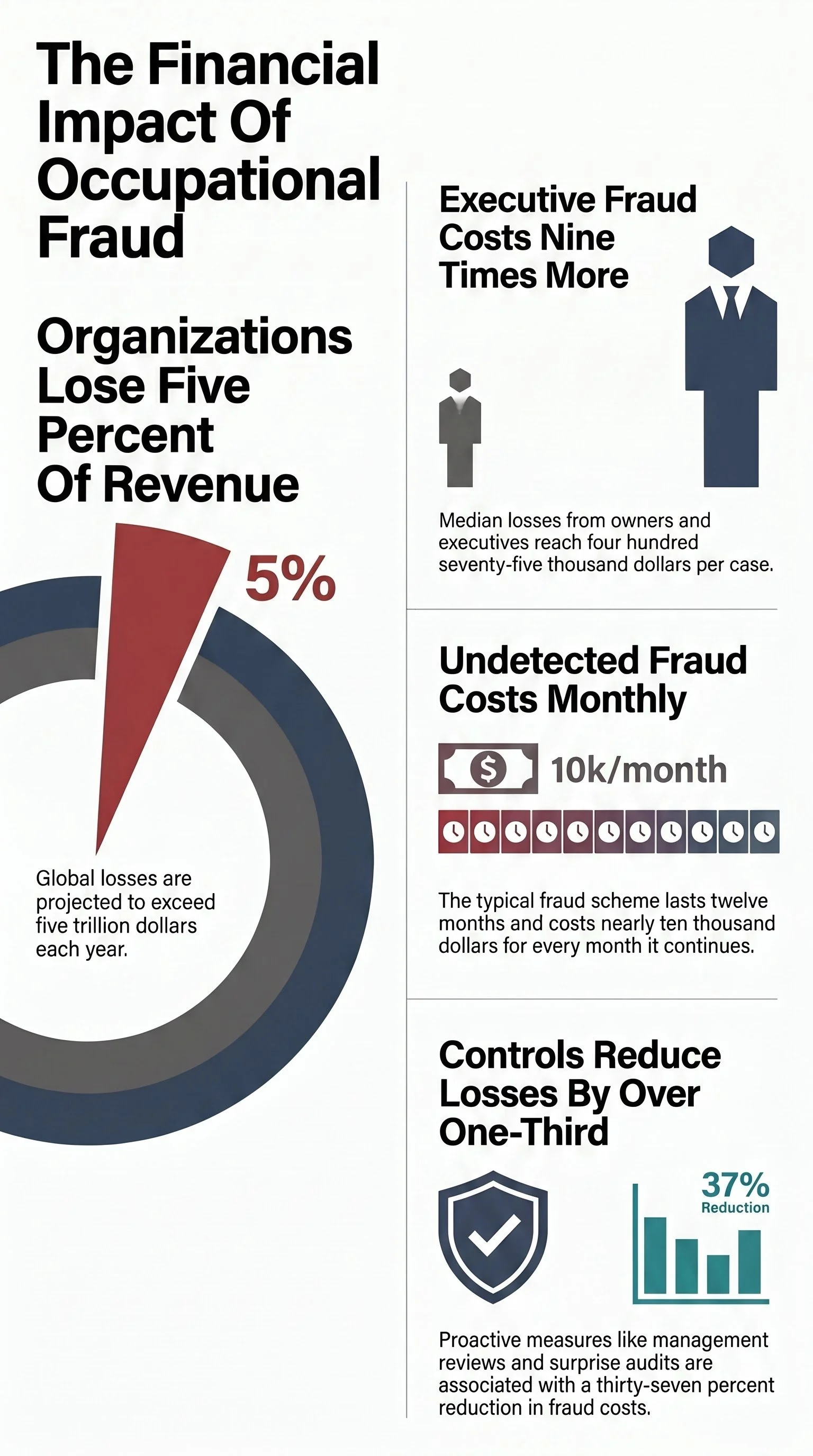
For CEOs, CFOs, COOs, CROs, CIOs, and CISOs, the concern is not simply whether fraud exists. The concern is whether the business can see weak signals early enough to intervene. That requires connecting activity across people, systems, vendors, accounts, transactions, and controls.
Fraud & Risk Analytics creates that connected view. It helps leadership move from after-the-fact loss review to earlier identification of patterns that deserve attention.
Give executives earlier visibility into the patterns behind financial and operational loss.
Fraud analytics helps leadership see where business activity is drifting from expected behavior.
That may include unusual payment timing, abnormal refund patterns, repeated vendor exceptions, suspicious account changes, shipping anomalies, employee misuse, or transactions that differ from peer behavior.
The goal is not to flag everything as fraud. The goal is to identify the events that deserve review, the patterns that need controls, and the workflows where financial or operational exposure is becoming measurable.
Turn fragmented transactions and exceptions into risk signals leaders can act on.
Solutioned helps clients design fraud and risk analytics around the business decisions they need to improve. That may include anomaly detection, risk scoring, rule-and-model hybrid detection, dashboard design, investigation workflows, control gap analysis, or targeted prototypes against real business data.
This work is distinct from general security data science. Fraud & Risk Analytics focuses on business process risk: how money, inventory, access, accounts, and operational decisions can be manipulated or misused.
Focus analytics on the business workflows where loss can hide.
Fraud analytics should begin with business context.
The most useful signals usually come from connecting transactions, users, accounts, devices, approvals, exceptions, and operational history. These workstreams help identify where abnormal activity is most likely to create financial, operational, or reputational impact.
-
We assess where analytics can realistically improve fraud and risk detection. The review examines business workflows, historical loss patterns, available data, control gaps, operational exceptions, stakeholder needs, and investigation capacity. The outcome is a prioritized view of fraud analytics opportunities that are practical to pursue.
-
We design anomaly detection approaches for payments, refunds, claims, shipments, account changes, procurement activity, customer behavior, or other business transactions. The focus is on finding patterns that differ meaningfully from expected behavior and can be reviewed by the right team.
-
Fraud and misuse often appear as repeated exceptions rather than a single dramatic event. We help clients analyze override activity, unusual approvals, policy exceptions, access misuse, abnormal timing, repeated reversals, and other patterns that may indicate control weakness or abuse.
-
Investigation teams sometimes need guidance with prioritization. We help design risk scoring approaches that combine rules, behavioral features, transaction context, peer comparison, historical outcomes, and business impact so teams can focus on higher-value cases.
-
Analytics only creates value when signals lead to action. We help define triage criteria, evidence requirements, escalation rules, case documentation, investigation ownership, and feedback loops so analysts, finance, operations, security, and risk teams can respond consistently.
-
When a high-value use case needs proof before larger investment, we can support focused prototype development. Prototype work may include data preparation, feature design, anomaly scoring, model evaluation, and recommendations for operationalizing the results.
Start when financial or operational exceptions are raising questions leadership cannot answer quickly.
Fraud and risk analytics often becomes urgent when leadership sees repeated exceptions, unexplained loss, control uncertainty, or suspicious behavior across systems that do not naturally talk to each other. These triggers indicate that the organization may need a more connected view of risk.
-
Individual events may look explainable, while a broader pattern could suggest abuse or control weakness. We help connect events across systems, users, accounts, and time periods to identify whether a meaningful risk pattern exists.
-
Manual review can miss subtle or repeated patterns, especially as transaction volume grows. We help identify where analytics can prioritize review, reduce noise, and surface exceptions that deserve closer attention.
-
Fraud detection often crosses organizational boundaries. We help define what each team sees, what data each team owns, how cases should be routed, and where analytics can create a shared risk picture.
-
A focused analytics prototype can help leadership test whether available data can produce useful fraud signals before committing to a platform, team expansion, or long-term program.
-
After a loss or near miss, the organization needs to understand whether the same pattern could happen again. We help convert incident lessons into detection logic, risk indicators, and control improvements.
Leave with fraud risk artifacts that connect analytics to action.
A useful fraud analytics engagement should not end with a dashboard alone. The organization should walk away with a clearer understanding of where loss can hide, what signals are worth reviewing, and how teams should respond when those signals appear.
A typical engagement may include:
Fraud analytics opportunity assessment
Business workflow and control gap review
Fraud risk data inventory
Transaction anomaly detection design
Operational exception pattern analysis
Risk scoring and prioritization model design
Feature engineering specification
Investigation workflow and evidence model
Prototype analytics concept
Executive summary and prioritized fraud risk roadmap
Connect fraud analytics experience to measurable business risk decisions.
Our Fraud & Risk Analytics work is founder-led and grounded in hands-on experience building machine learning and rules-based analytics for security, operational risk, and fraud detection.
The founder’s background includes predictive modeling, anomaly detection, behavioral analytics, SQL and R-based investigation workflows, data pipelines, technical investigations, and enterprise-scale security analytics.
It also includes developing an autonomous fraud detection machine learning model that reduced a Fortune 500 company’s annual shipping fraud losses by 96%.
That experience matters because fraud analytics requires more than a model. It requires understanding how business workflows are abused, which signals are explainable, which exceptions are worth escalating, and how to design outputs that finance, operations, risk, security, and IT teams can trust.
Move from isolated exceptions to a repeatable fraud risk decision process.
Fraud analytics works best when the organization begins with a clear business workflow and decision point. We use a practical process that maps where loss can occur, evaluates available data, designs signals, and connects analytics to investigation or control action.
We identify the business process, loss concern, stakeholder group, decision point, and expected action that the analytics should support.
Step 1: Frame
Identify the business process, loss concern, stakeholder group, decision point, and expected action.
Step 2: Map
Document systems, transactions, users, vendors, approvals, exceptions, controls, and historical incidents or near misses.
Step 3: Signal
Define candidate indicators, features, rules, anomaly patterns, peer comparisons, and risk scores.
Step 4: Test
Evaluate whether the signals are explainable, usable, and practical given data quality and investigation capacity.
Step 5: Operationalize
Translate analytics into triage workflows, escalation logic, documentation expectations, and a prioritized roadmap.
Resolve the fraud analytics questions before expanding the program.
Fraud analytics touches money, operations, employee behavior, customer activity, and control ownership. These questions help executives and technical leaders understand what the work is designed to do and how it fits alongside existing finance, risk, audit, security, and IT functions.
-
It is both. Many fraud patterns involve business processes, but they also rely on identity, access, email, device behavior, data movement, and system activity. The engagement connects those signals so the organization can detect risk earlier.
-
No. Many organizations begin with existing data from finance systems, identity systems, ticketing tools, transaction records, email security, event management systems, or operational systems. A focused assessment can determine whether a dedicated platform is necessary later.
-
Yes. Fraud and misuse can affect shipping, refunds, customer credits, inventory, procurement, vendor changes, employee activity, account administration, benefits, claims, or operational exceptions. The analytics should be tailored to the business process.
-
The work should prioritize explainable signals and practical thresholds. We design scoring, triage criteria, context fields, and feedback loops so teams can focus on higher confidence cases instead of broad alert volume.
-
Typical stakeholders include finance, operations, security, IT, risk, internal audit, fraud investigations, data engineering, application owners, and business leaders responsible for the workflow being assessed.
-
Yes. Fraud analytics can produce evidence of control improvement, risk monitoring, investigation workflow, and management oversight. The outputs can support internal audit, board reporting, insurance conversations, and customer due diligence where relevant.
-
Success can be measured through earlier detection of suspicious patterns, reduced manual review burden, clearer investigation prioritization, fewer repeated control failures, stronger evidence quality, and better executive visibility into fraud risk exposure.
Schedule a consultation to identify where fraud risk may be hiding in the business.
Solutioned helps organizations connect transactions, behaviors, exceptions, and controls so fraud and operational risk can be seen earlier.