

Security Data Science & Machine Learning Services
Find the weak signals that rules, dashboards, and manual triage miss.
Security data is abundant, but decision-quality signal is scarce.
Many security programs collect more telemetry than their teams can reasonably interpret. Rules help, but rules are brittle. Dashboards help, but dashboards depend on someone knowing where to look. Alerts help, but only when they are specific enough to justify action.
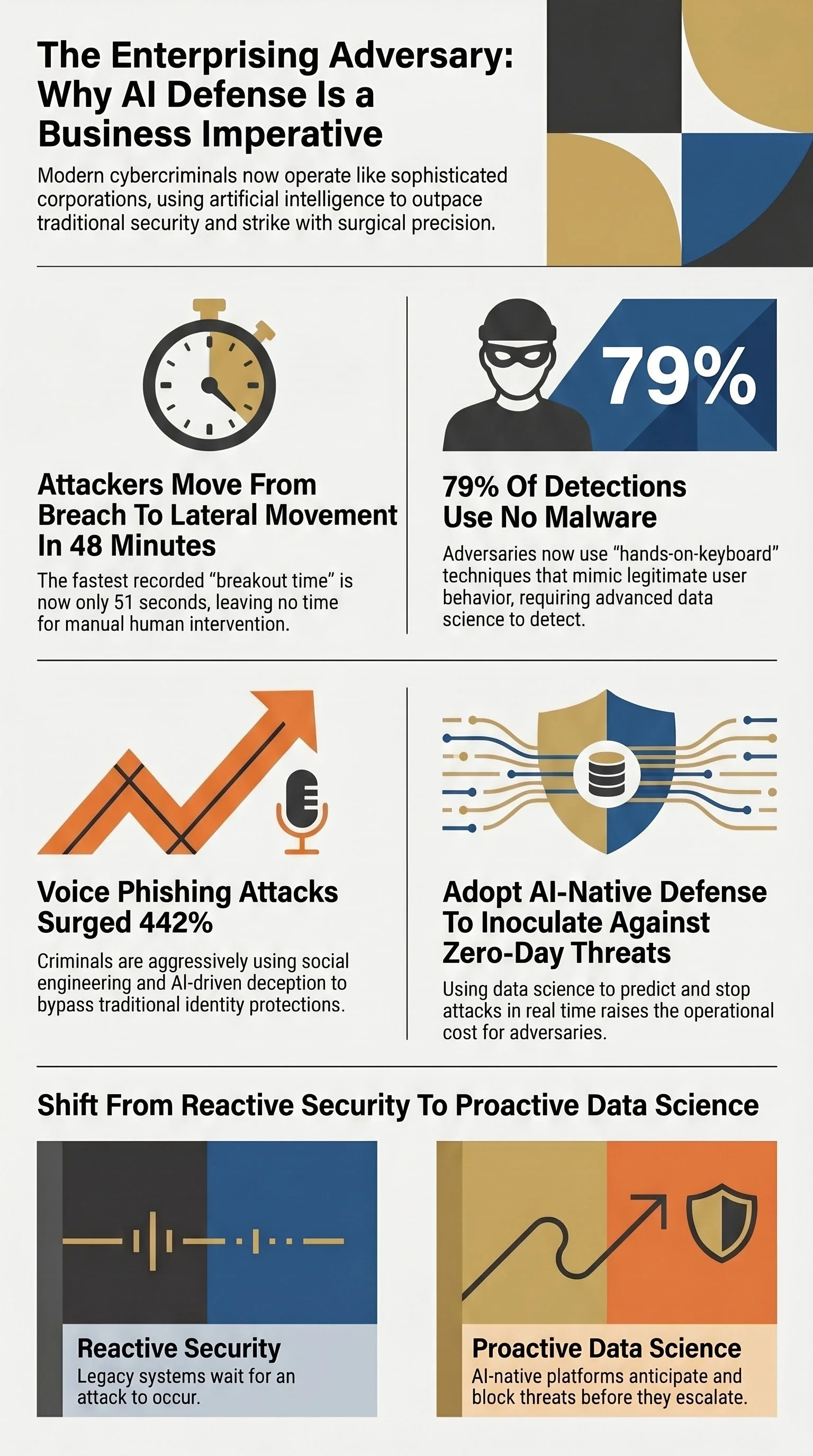
Machine learning and data science can improve that equation when they are applied carefully. The goal is not to add “AI” for novelty. The goal is to model behavior, reduce noise, surface anomalies, score risk, prioritize investigations, and make security operations more adaptive.
For executives, the key question is not whether the organization has enough logs. The better question is whether the business can identify meaningful patterns in time to reduce risk.
Use analytics to focus attention before risk becomes obvious.
Security data science helps leadership move from reactive review to earlier prioritization. Instead of waiting for an alert to become obvious, analytics can help identify patterns of concern: unusual access, rare destinations, abnormal traffic cadence, unexpected file movement, suspicious authentication behavior, or activity that differs from peer behavior.
The value is not in replacing analysts. The value is in giving analysts and leaders better context: which events deserve review, which patterns are changing, which signals are weak but important, and which use cases are mature enough to operationalize.
Build security analytics that can be explained, trusted, and operationalized.
Solutioned designs analytics programs that connect security use cases to data quality, feature engineering, model selection, evaluation, explainability, and operational workflows. The work can range from opportunity assessment to prototype design, model validation, or security operations integration.
This service is not about generic data science. It is about applying analytics to security problems where adversary behavior, business context, telemetry quality, and operational trust all matter.
Select the analytics workstream that matches the decision your team needs to improve.
Security analytics should start with the decision the organization wants to make better.
That decision may involve prioritizing alerts, detecting abnormal behavior, reducing analyst workload, scoring risk, identifying data exfiltration patterns, or validating whether a model is ready for operational use. These workstreams focus the effort on measurable security outcomes rather than open-ended experimentation.
-
We identify where data science and machine learning can realistically improve security outcomes. The assessment reviews use cases, available telemetry, data quality, operational workflows, stakeholder expectations, and feasibility so leadership can distinguish practical analytics opportunities from low-value AI experimentation.
-
We design anomaly detection approaches for security behaviors such as unusual authentication, abnormal network activity, rare destinations, unexpected cloud behavior, suspicious file movement, or user activity that differs from peers. The emphasis is on patterns that can be investigated and explained, not abstract model scores with no operational path.
-
Machine learning quality depends on the features behind the model. We review whether the available data can support meaningful analytics, then define the derived features, aggregations, baselines, peer groups, time windows, and enrichment fields needed to make the model useful.
-
Security teams often need better prioritization, not more alerts. We help design scoring models and analytic workflows that rank activity by likelihood, severity, novelty, business context, or investigation value so teams can focus on higher confidence signals.
-
When a use case is promising, we can support prototype development to test whether a model can detect meaningful patterns using real or representative telemetry. Prototype work may include feature design, model selection, evaluation criteria, explainability requirements, and operational recommendations.
Start when more telemetry is no longer producing better judgment.
Security data science is often most useful when the organization already has data but lacks a reliable way to prioritize it. These triggers suggest that analytics or modeling could help convert existing telemetry into clearer decisions.
-
Large volumes of telemetry can slow response when every signal appears equally urgent. Analytics can help rank events, enrich context, and identify which patterns deserve analyst attention first.
-
Rules work well for known patterns, but many security behaviors shift across users, systems, time periods, and environments. Behavioral baselines and anomaly detection can help identify activity that does not fit expected patterns.
-
Not every security problem needs machine learning. We help separate use cases that benefit from analytics from those better solved through rules, process changes, better logging, or platform tuning.
-
Models need coherent data. We help identify which data sources matter, where enrichment is needed, and how telemetry should be shaped before analytics can produce reliable outputs.
-
Analysts will ignore model outputs they cannot understand. We help improve model explainability, artifact presentation, triage context, and feedback loops so analytic results support real investigation decisions.
-
A focused prototype can reduce uncertainty before a larger investment. We help define the hypothesis, data requirements, evaluation approach, and operational fit so leadership can decide whether to proceed.
Leave with analytics artifacts that connect models to security operations.
A useful security data science engagement should not end with a notebook or a vague AI recommendation. The work should produce artifacts that help the organization evaluate, trust, and operationalize analytics in a security environment.
A typical engagement may include:
Security analytics opportunity assessment
Use case feasibility and prioritization matrix
Data readiness and telemetry quality review
Feature engineering specification
Candidate model design and evaluation approach
Anomaly detection or risk scoring prototype plan
Model explainability and artifact requirements
Analyst workflow and feedback-loop design
Executive summary and implementation roadmap
Use production security analytics experience to make models operational.
Our Security Data Science & Machine Learning practice is grounded in direct experience building production analytics for information security. The founder’s background includes predictive modeling, feature engineering, anomaly detection, user behavior analytics, R, Apache Spark, Kafka, UBA, and security solution architecture.
It also includes building enterprise insider threat and malware detection systems that processed high volume telemetry, routed alerts to responders, and supported real operational decisions
That experience matters because security ML is not a lab exercise. A useful model must survive incomplete data, changing behavior, adversarial pressure, analyst skepticism, operational constraints, and executive scrutiny.
Move from analytics curiosity to a defensible production path.
Security data science works best when it is intentionally scoped.
We use a decision-first process that starts with the business or security outcome, then works backward through data, features, models, validation, and operational integration. The result is a practical path from idea to trusted capability.
We define the security decision the model or analytic workflow is meant to improve, the stakeholders who will use the output, and the operational action that should follow.
Step 1: Frame
Define the decision the model or analytic workflow is meant to improve and the action that should follow.
Step 2: Inspect
Review data sources, telemetry quality, enrichment fields, time windows, missingness, volume, permissions, and workflow constraints.
Step 3: Design
Identify candidate features, model types, scoring approaches, baselines, evaluation measures, explainability expectations, and artifact requirements.
Step 4: Validate
Test whether the analytic approach produces useful signal, acceptable noise, defensible outputs, and practical investigation value.
Step 5: Operationalize
Translate the design into deployment recommendations, workflow integration, feedback loops, and roadmap actions.
Answer the practical questions before introducing machine learning into security workflows.
Machine learning can create value, but only when expectations are realistic and the operating model is clear. These questions address the concerns executives and technical leaders typically raise before investing in security analytics.
-
Not always. Some security problems are better solved with rules, tuning, better logging, or process improvements. We evaluate whether machine learning is justified by the use case, data, variability, and decision need.
-
Yes, if the scope is practical. Some clients need advisory support, feasibility analysis, or prototype design. Others need help defining a roadmap that internal engineers, data teams, or future hires can execute.
-
Usually, yes. The engagement can work with existing telemetry from SIEM, EDR, identity, cloud, network, proxy, email, DLP, ticketing, or data platforms. The important question is whether the data is complete and consistent enough to support the intended decision.
-
The answer depends on the use case. Some models need long historical baselines. Others can begin with smaller datasets, targeted features, or hybrid approaches that combine rules and analytics. We assess data needs before recommending implementation.
-
Yes, when designed properly. Security analytics can support reporting by showing what risk is being modeled, what data supports the model, how outputs are reviewed, and how the organization uses those outputs to improve security decisions.
-
Success can be measured through better prioritization, reduced noise, improved analyst trust, earlier detection of abnormal behavior, clearer artifacts, operational adoption, and a roadmap for analytics use cases that are worth continuing.
Schedule a consultation to identify where analytics can improve security decisions.
Security teams do not need more disconnected data experiments. They need practical analytics that improve prioritization, detection, investigation, and leadership confidence.