

Insider Threat Detection & Data Loss Prevention Services
Protect sensitive data by detecting risky access, movement, and exposure before it becomes an incident.
The hardest data risks often look like legitimate work.
A traditional security alert may tell you that something happened. Insider threat and DLP work asks a harder question: did the activity make sense for that user, that data, that destination, that timing, and that business context?
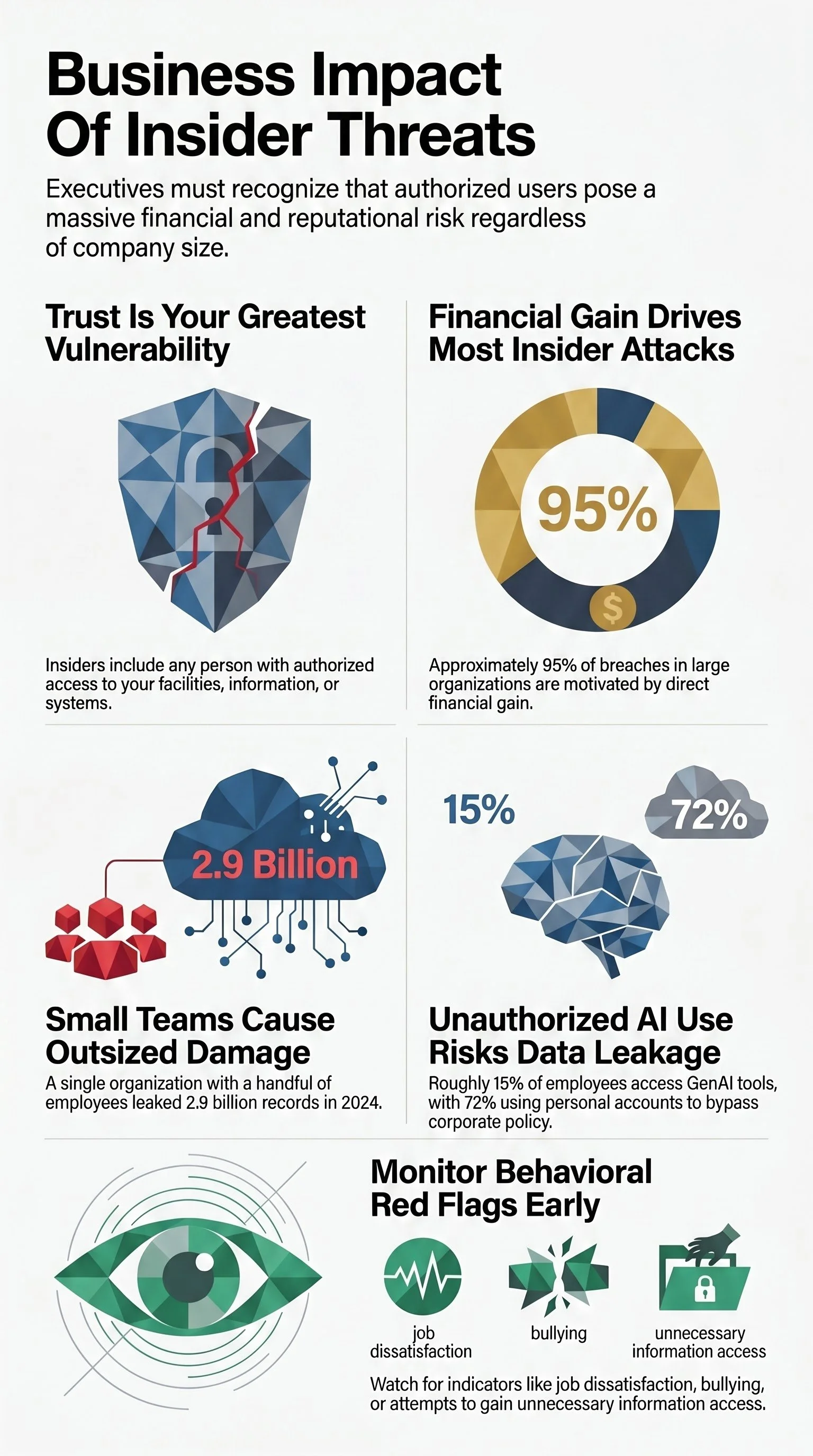
That distinction matters. Sensitive information now moves through cloud drives, SaaS platforms, code repositories, collaboration tools, personal productivity workflows, email, endpoints, privileged accounts, and third-party access paths.
When those workflows are poorly governed, the organization may not know whether critical data is protected, overexposed, or already outside expected channels and creating unseen risk.
For C-suite leaders, the concern is not simply whether a DLP product is installed. The concern is whether the business can explain who can access sensitive data, where that data can go, what risky movement looks like, and how security, legal, HR, privacy, and IT should respond when the signal is real.
Create a data protection program precise enough to reduce risk and careful enough to preserve trust.
Insider threat and DLP programs fail when they are too broad, too noisy, or too disconnected from business reality. The objective is not to monitor everything. The objective is to be intentional by focusing attention on the data, users, systems, behaviors, and transfer paths that matter most.
A stronger program gives leadership a clearer answer to practical questions: Which data is most exposed? Which users and roles create elevated risk? Which policies produce useful signal? Which alerts waste time? Which cases need legal, HR, privacy, or executive involvement? Which improvements should happen first?
Turn DLP from policy noise into governed, risk-based data protection.
Solutioned focuses insider threat and DLP work around the business reality of sensitive data: where it lives, who can access it, how it moves, and what artifacts are needed when activity becomes risky.
The work can include assessment, architecture, policy modernization, detection design, behavioral analytics, workflow development, or executive roadmap support. The emphasis is on practical control improvement, not tool theater.
Focus the work on the places where sensitive data can actually leave the business.
Insider threat and DLP engagements should begin with the organization’s real exposure paths, not a generic checklist. These workstreams examine the data, access, behavior, policies, and response workflows that determine whether the business can detect and contain sensitive data risk.
-
We examine where sensitive data is most likely to be exposed across users, systems, repositories, cloud platforms, endpoints, SaaS tools, and collaboration workflows. The goal is to identify the highest risk data paths and the control gaps that make exposure difficult to prevent, detect, or explain.
-
DLP policies often become noisy because they are written around generic data patterns instead of specific business context. We review existing policies, alert logic, thresholds, exceptions, and enforcement models to identify where policies should be tightened, retired, tuned, or redesigned.
-
We design analytics that look for patterns of concern, such as unusual downloads, abnormal file access, suspicious cloud movement, risky behavior near employee departure, privileged user anomalies, or activity that does not fit a user’s role. The emphasis is on context, not broad monitoring.
-
Employee transitions, privileged roles, contractors, and sensitive business functions can create elevated data risk windows. We help define focused monitoring scenarios, artifact expectations, escalation criteria, and response workflows for these higher-risk situations.
-
We identify practical detection opportunities for sensitive data movement across email, cloud storage, collaboration tools, removable media, proxies, endpoints, repositories, and unusual outbound transfer paths. The output is a prioritized set of use cases that can be implemented with available telemetry.
-
Insider threat cases require careful handling. We help define what artifacts needed, when a case should escalate, who should be involved, how findings should be documented, and how security teams can coordinate with legal, HR, privacy, and business stakeholders.
Start when a data risk concern has become a leadership question.
Insider threat and DLP work often begins when leadership needs a defensible answer, not just another dashboard. These triggers indicate that the organization needs better visibility into sensitive data movement, access risk, and response accountability.
-
This question often exposes gaps between access control, data classification, and actual business workflows. We help identify where sensitive data can be accessed, copied, transferred, or exposed by users with legitimate permissions.
-
A noisy DLP program can create the illusion of control while overwhelming the people responsible for response. We help separate high value signals from policy noise and improve the context analysts need to make decisions.
-
Risk often increases when people or business relationships change. We help design focused detection and governance models for employee exits, contractor access, privileged roles, and other elevated risk scenarios.
-
Cloud drives, SaaS platforms, shared repositories, and collaboration tools can make sensitive data easier to use and harder to govern. We help assess where these workflows create exposure and which controls should be prioritized.
-
Stakeholders increasingly expect organizations to explain how sensitive data is protected. We help translate insider threat detection and DLP capabilities into artifacts that support due diligence, audit readiness, and executive reporting.
-
When sensitive data may have moved outside expected channels, the organization needs clear facts. We help reconstruct relevant activity, identify available artifacts, and support a measured response that avoids speculation.
Leave with artifacts, priorities, and a response model that stakeholders can align around.
A useful insider threat engagement should produce more than a list of control gaps. The organization should walk away with a clearer view of sensitive data exposure, better policy direction, practical detection opportunities, and a response model that security, legal, HR, privacy, and IT can use.
A typical engagement may include:
Sensitive data exposure and movement assessment
DLP policy quality review
High risk user, role, and access scenario mapping
Third-party and contractor data access review
Departing employee risk workflow recommendations
Cloud, SaaS, endpoint, identity, and repository telemetry review
Data exfiltration detection use case backlog
Behavioral analytics design recommendations
Alert triage and investigation evidence model
Legal, HR, privacy, and security governance alignment notes
Executive summary and prioritized data protection roadmap
Bring deep insider threat analytics experience to sensitive data protection.
Our insider threat and DLP work is grounded in direct enterprise experience building detection systems for sensitive data protection.
The founder’s background includes insider threat management, DLP, technical investigations, eDiscovery, user behavior analytics (UBA), machine learning, and security architecture. That experience includes architecting and building a global insider threat detection ecosystems, modeling daily events, and generating a majority of actionable alerts handled by incident responders.
That matters because insider risk programs sit at a difficult intersection: people, data, access, privacy, legal process, HR sensitivity, and security operations. The work requires both technical depth and expertise about proportionality, artifact quality, escalation, and business impact.
Translate sensitive data risk into a managed improvement sequence.
Insider threat programs can become operationally heavy if they are not scoped carefully.
We use a structured process that starts with business context, narrows the focus to meaningful exposure paths, and turns findings into actions that can be implemented without overwhelming the organization.
We identify the business drivers, sensitive data priorities, stakeholder concerns, legal or privacy boundaries, and the types of data movement that would create material risk.
Step 1: Align
Identify business drivers, sensitive data priorities, stakeholder concerns, legal and privacy boundaries, and material risk scenarios.
Step 2: Inventory
Review tools, repositories, user populations, DLP policies, telemetry sources, access paths, cloud services, and investigation workflows.
Step 3: Trace
Map how sensitive data can move across users, roles, systems, collaboration platforms, repositories, endpoints, and external destinations.
Step 4: Calibrate
Distinguish high-value indicators from noisy signals and define where policies, analytics, thresholds, or escalation criteria should change.
Step 5: Operationalize
Convert findings into prioritized recommendations, detection use cases, workflow improvements, stakeholder responsibilities, and roadmap artifacts.
Resolve the sensitive questions before the program expands.
Insider threat and DLP work requires more care than many cybersecurity projects because it touches employees, contractors, sensitive business data, legal obligations, privacy expectations, and internal trust. These questions help clarify how the work should be scoped and governed.
-
No. The work is focused on protecting sensitive data and understanding risky activity in a targeted, proportionate way. A defensible program should be governed, documented, and aligned with legal, privacy, HR, and security expectations.
-
The engagement can include stakeholder alignment, escalation criteria, and documentation practices so that monitoring and investigations are tied to legitimate business risk rather than broad or ambiguous observation.
-
Not necessarily. Some organizations begin with a readiness assessment, data movement review, or policy design effort before investing in tooling. Others already have DLP and need help making it more precise, actionable, and aligned to business risk.
-
Yes. The work can use available telemetry from identity systems, endpoints, cloud platforms, email, proxies, SIEM, DLP tools, repositories, and collaboration platforms. The goal is to improve outcomes using the data sources that are realistic for the client’s environment.
-
The objective is to reduce avoidable exposure without blocking normal work unnecessarily. That means focusing on high risk data, high risk movement, and high-risk context instead of applying broad controls that frustrate users and create excessive exceptions.
-
Typical stakeholders include security, IT, privacy, legal, HR, compliance, data owners, endpoint administrators, identity owners, cloud platform owners, and business leaders responsible for sensitive information.
-
Improvement can be measured through clearer sensitive data visibility, reduced DLP noise, better alert context, more defensible investigations, improved third-party access governance, stronger departure risk handling, and a prioritized roadmap for reducing exposure.
Schedule a consultation to bring structure to insider-risk and data-protection questions.
Sensitive data protection becomes easier to manage when the organization understands where exposure can happen, which behaviors matter, and how stakeholders should respond.