

Secure RAG & LLM Platform Services
Build AI systems that can use business knowledge without exposing more than they should.
Enterprise AI becomes risky when retrieval is treated as a search problem instead of an architecture problem.
A basic AI assistant can answer general questions.
A business-grade AI system needs more structure. It must know which sources are trusted, which users are authorized, which content is current, which data should never be retrieved, and which answers require evidence.
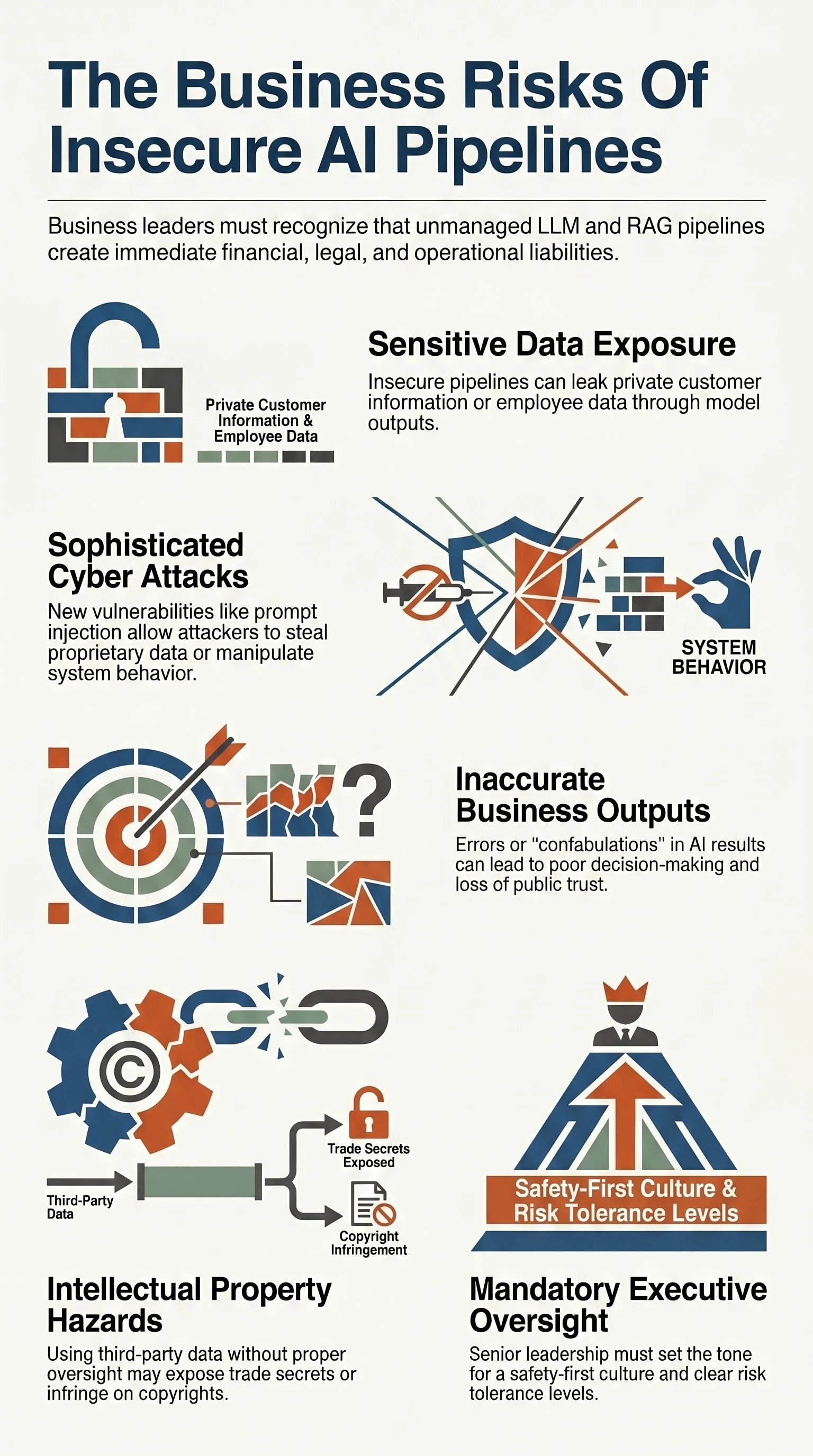
For CEOs, CIOs, CTOs, CISOs, and Chief Data Officers, the concern is not whether the organization can connect an LLM to documents. The concern is whether the resulting system can be trusted inside real workflows: customer support, legal review, technical operations, policy interpretation, product knowledge, security analysis, research, or internal decision support.
Secure RAG architecture brings order to that problem. It separates knowledge ingestion, retrieval, permissions, prompt construction, model interaction, response validation, logging, and monitoring into deliberate layers. That makes AI more useful to the business and more defensible to security, privacy, legal, and engineering stakeholders.
Make enterprise AI useful without making sensitive data easier to misuse.
A secure RAG platform gives leadership a safer path to AI adoption. Instead of sending employees to public tools or building disconnected prototypes, the organization can create governed AI experiences around trusted data sources, defined access rules, controlled retrieval, and observable usage.
The result is a platform that supports productivity without forcing the business to choose between speed and control. Users get better answers. Security teams get visibility. Data owners retain boundaries. Executives get a clearer path from AI experimentation to operational deployment.
Design the retrieval, permission, and governance layers before scaling the AI experience.
Our RAG and LLM platform work focuses on the architecture beneath the interface. The goal is not just to build a chatbot. The goal is to design the system of record connections, retrieval logic, access controls, prompt patterns, evaluation process, audit trail, and operating model that allow the platform to be trusted.
This work is especially valuable for organizations that want private knowledge assistants, internal research tools, security copilots, policy assistants, customer-support augmentation, technical documentation search, or multimodal classification workflows.
Start with the platform layer that determines whether AI can be trusted in the business.
RAG and LLM systems fail when the organization focuses only on the model or interface. These workstreams address the architectural layers that determine whether the system retrieves the right information, respects permissions, produces data-backed responses, and can be governed over time.
-
We design the target architecture for retrieval-augmented generation systems, including knowledge ingestion, retrieval logic, prompt construction, model interaction, response handling, logging, and monitoring. The output is a platform blueprint that technical teams can build from and leadership can govern.
-
RAG systems should not retrieve information simply because it exists in an index. We help design retrieval patterns that account for identity, role, document permissions, data sensitivity, tenant boundaries, and business context before information is passed to the model.
-
A secure LLM platform needs more than clever prompts. We define prompt templates, context-handling patterns, system instructions, artifact requirements, response constraints, and answer formatting so outputs are more consistent, explainable, and aligned with business use.
-
Many valuable AI use cases require integration with applications, APIs, ticketing systems, document repositories, security platforms, or business workflows. We design integration patterns that preserve least privilege, logging, approval paths, and operational control.
-
For organizations working with text, images, documents, or mixed media, we design LLM-assisted classification pipelines that combine model outputs with business rules, human review, metadata, and validation controls. This is useful when the organization needs repeatable analysis without giving the model unrestricted authority.
Act when AI pilots begin touching real data, real users, or real decisions.
Many organizations can create a promising AI prototype quickly. The harder question is whether the prototype can safely become a business capability. These triggers indicate that leadership may need architecture support before scaling RAG or LLM systems.
-
Prototype success does not automatically translate into production readiness. We assess whether the design has adequate access control, retrieval quality, source governance, logging, testing, and ownership before broader rollout.
-
Connecting AI to internal content can create immediate value, but it also raises questions about permissions, sensitive data, document ownership, and answer reliability. We help design the guardrails before the assistant becomes widely used.
-
A private AI assistant still needs architecture. We help define how the system retrieves knowledge, protects sensitive sources, records usage, handles unsafe prompts, validates outputs, and integrates with existing identity and data platforms.
-
Confident answers without supporting artifacts create business risk. We design retrieval and response patterns that emphasize source grounding, citations, traceability, and evaluation so users can understand where answers came from.
-
RAG platforms sit across multiple ownership boundaries. We help define stakeholder responsibilities, risk decisions, approval paths, and control expectations so the platform does not become an unmanaged technology experiment.
-
AI strategy becomes useful when it is translated into architecture, sequencing, and implementation decisions. We create practical roadmaps that connect use cases, data sources, controls, integration patterns, and delivery milestones.
Leave with architecture artifacts that connect AI ambition to implementation reality.
A secure RAG engagement should produce more than a concept diagram. The organization should walk away with practical artifacts that help engineering teams build, security teams review, data owners govern, and executives decide what should happen next.
A typical engagement may include:
Secure RAG target architecture
Knowledge source and data readiness assessment
Permission-aware retrieval design
LLM platform integration blueprint
Prompt and response architecture recommendations
Retrieval quality and evaluation plan
AI logging, monitoring, and auditability recommendations
Prompt-injection and sensitive data risk considerations
Multimodal classification workflow design
Governance and stakeholder responsibility model
Executive roadmap and implementation sequence
Design AI knowledge systems with security architecture discipline.
Our RAG and LLM platform work is founder-led and grounded in hands-on architecture and implementation experience.
The founder’s background includes designing custom retrieval-augmented generation pipelines, integrating large language models, building multimodal AI workflows, developing machine-learning systems, architecting cloud-first security platforms, and translating technical roadmaps into enterprise risk-reduction outcomes.
That combination matters because production AI is not one discipline. It requires data architecture, security architecture, software integration, model evaluation, workflow design, privacy awareness, and executive communication.
Move from AI prototype to controlled platform design.
RAG and LLM work should progress through architecture decisions before broad deployment.
We use a platform-first process that clarifies the use case, maps the data environment, defines access and governance boundaries, designs the retrieval system, and creates an implementation path that technical teams can execute.
We identify the business use case, target users, data sources, risk boundaries, success criteria, and operating assumptions for the AI capability.
Step 1: Define
Identify the business use case, target users, data sources, risk boundaries, success criteria, and assumptions.
Step 2: Inspect
Review documents, repositories, APIs, identity systems, data classifications, permissions, AI tooling, and integration constraints.
Step 3: Architect
Design retrieval, indexing, prompt, model, access-control, logging, and response-handling layers.
Step 4: Evaluate
Define testing methods for retrieval accuracy, answer quality, sensitive-data exposure, prompt-injection resilience, citation quality, and reliability.
Step 5: Sequence
Translate the design into a roadmap with implementation phases, stakeholder responsibilities, risk decisions, and follow-on options.
Answer the platform questions before the AI assistant becomes business-critical.
RAG and LLM systems raise architectural questions that are easy to miss during experimentation. These questions help executives and technical leaders understand what must be designed before a pilot becomes a production capability.
-
Not always. Many organizations can begin with a commercial model, private endpoint, or managed AI service if the surrounding architecture handles data boundaries, permissions, logging, and evaluation. The model decision should follow the risk and use case, not drive it.
-
Yes, but it must be designed intentionally. Permission-aware retrieval requires the system to evaluate user identity, role, source permissions, data sensitivity, and retrieval context before supplying information to the model.
-
RAG can reduce unsupported answers when the retrieval layer is well designed and responses are grounded in trusted sources. The system still needs answer evaluation, source citation, response constraints, and testing against real business questions.
-
Data should be excluded or tightly controlled when it is sensitive, stale, restricted, or likely to create more risk than value. A data-readiness review helps make those decisions explicit.
-
Typical stakeholders include the CIO, CTO, CISO, Chief Data Officer, product owner, security architect, data governance lead, privacy or legal representative, application owner, identity owner, and engineering lead.
-
Success can be measured through safer access to internal knowledge, improved answer quality, lower unmanaged AI usage, better source traceability, clearer governance, reduced sensitive data exposure, and a roadmap that moves AI from experiment to controlled capability.
Schedule a consultation to design AI systems that are useful, governed, and secure.
Secure RAG architecture helps organizations unlock internal knowledge without turning sensitive data into an unmanaged AI dependency.