

Generative AI Security Services
Adopt generative AI without losing control of data, access, or accountability.
Generative AI risk grows when adoption happens faster than oversight.
The central challenge is not whether generative AI should be used. In most organizations, it already is.
The issue is whether leadership understands where AI is being used, which data is entering AI systems, which tools are approved, which outputs are trusted, and who owns the resulting risk.
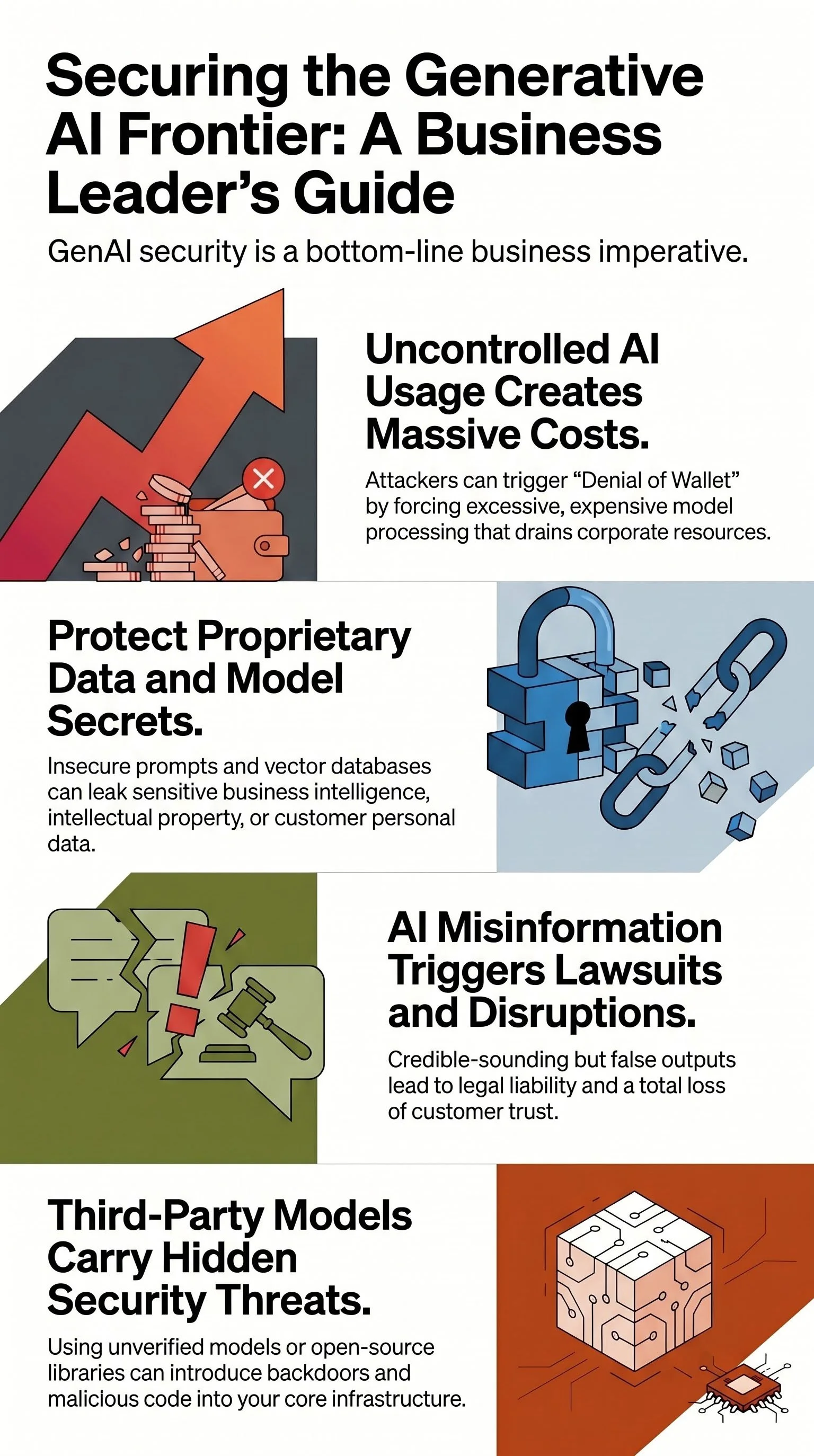
A public AI tool may receive sensitive business context. A SaaS platform may quietly introduce AI features. A department may automate a workflow without security review. A model may produce convincing but unsupported output. A developer may use AI generated code without enough validation. None of these scenarios requires malicious intent to create business exposure.
For CEOs, CIOs, CTOs, CISOs, General Counsel, and Chief Data Officers, the practical question is whether AI adoption is becoming a managed capability or an unmanaged dependency.
Give leadership a clear way to say yes to AI without accepting unmanaged risk.
A strong GenAI security program should not simply block AI usage. Blocking everything usually drives adoption underground. The better outcome is disciplined enablement: approved tools, clear policies, sensitive data boundaries, usage monitoring, vendor review, output validation, and escalation paths for high-risk use cases.
That gives executives a more practical control model. The organization can encourage useful AI adoption while reducing avoidable exposure from shadow AI, prompt leakage, poorly governed integrations, unsafe automation, and unclear accountability.
Build the governance, control, and monitoring layer around enterprise AI adoption.
We help organizations define how generative AI should be used, where it should be restricted, which risks should be monitored, and which controls must exist before broader deployment.
This work is distinct from building a RAG platform. GenAI Security focuses on the enterprise adoption layer: policy, access, data protection, vendor risk, acceptable use, monitoring, response, and executive governance.
Select the GenAI security workstream that brings control to the adoption path.
Generative AI risk does not appear in just one place.
It shows up in employee behavior, SaaS platforms, developer workflows, data handling, model outputs, and internal automation. These workstreams help leadership understand where AI is being used and how to govern it without stopping innovation.
-
We assess the organization’s current AI usage, policies, approved tools, data handling practices, access controls, vendor exposure, monitoring capability, and governance ownership. The goal is to give leadership a clear view of where AI risk already exists and what should be addressed first.
-
Shadow AI often begins as productivity experimentation. We help identify where employees, teams, or business units may be using unapproved AI tools and assess the related risks to sensitive data, intellectual property, privacy, compliance, and operational accountability.
-
We help define practical AI usage policies that employees can actually follow. This may include approved and prohibited use cases, sensitive data restrictions, user responsibilities, tool approval criteria, escalation paths, and governance roles for security, legal, privacy, IT, and business leaders.
-
Prompts, uploads, embedded context, and generated outputs can create exposure when users do not understand what information should stay out of AI tools. We review high-risk workflows and define controls that reduce the likelihood of sensitive data entering unmanaged AI systems.
-
Executives need visibility into AI usage without creating a surveillance heavy environment. We design monitoring concepts that focus on approved tools, risky destinations, sensitive data movement, policy exceptions, and indicators that AI usage may be drifting beyond governance boundaries.
-
AI related incidents can involve sensitive prompts, exposed files, inappropriate outputs, privacy concerns, or unsafe automation. We help define how the organization should triage, investigate, escalate, document, and communicate AI related security or governance events.
Start when AI usage is becoming visible enough to create executive concern.
Most organizations do not begin with a mature AI governance program. They begin with scattered adoption, employee experimentation, or leadership questions. These triggers indicate that the business needs a clearer operating model for secure GenAI adoption.
-
This is often the first sign that AI adoption has moved ahead of governance. We help leadership understand the current state, identify sensitive use cases, and decide which tools and practices should be approved, restricted, or monitored.
-
AI governance crosses multiple ownership boundaries. We help align stakeholders around risk categories, approved use cases, data restrictions, escalation paths, and decisions that need executive sponsorship.
-
Leadership may need a defensible answer before approving broader AI adoption. We help translate technical and legal concerns into a clear executive view of AI risks, controls, priorities, and next steps.
-
AI assisted work can improve productivity, but it can also introduce data exposure, unreliable outputs, insecure code, or undocumented dependencies. We help define guardrails that support adoption without ignoring validation and accountability.
-
Policies are easier to implement before informal habits become business critical workflows. We help create practical policies that distinguish low risk usage from high risk decisions involving confidential data, regulated information, customers, source code, contracts, or security operations.
Leave with AI governance artifacts your leaders and teams can actually use.
GenAI security work should not end with abstract principles. The organization should walk away with practical artifacts that clarify what is allowed, what is risky, what must be monitored, and who owns the decisions.
A typical engagement may include:
GenAI security readiness assessment
Shadow AI risk review
Approved tool and use case inventory
AI acceptable use policy framework
Sensitive data and prompt risk guidance
AI usage monitoring recommendations
AI governance roles and responsibility model
High-risk AI workflow review
AI incident response and escalation playbook
Executive briefing and prioritized AI risk roadmap
Govern AI adoption with both implementation and security-risk context.
Our GenAI Security work is founder-led and grounded in hands-on experience designing custom generative AI, retrieval-augmented generation, multimodal AI, security analytics, and cloud-first security architectures.
The founder’s background includes LLM integration, custom RAG pipelines, multimodal data classification, machine learning, security architecture, insider threat detection, DLP, threat detection, AWS architecture, CISSP, and TOGAF-based solution architecture.
That combination matters because GenAI security is not only a policy exercise. It requires understanding how AI systems are built, how users actually adopt them, how sensitive data moves, how controls fail, and how executives need to make risk decisions.
Move from AI uncertainty to a controlled adoption model.
GenAI security should create enough structure for the business to move forward.
We use a practical governance-to-control process that clarifies current usage, defines risk boundaries, aligns stakeholders, and produces a roadmap for safer AI adoption. We identify current AI usage, planned initiatives, approved tools, informal practices, data concerns, and stakeholder priorities.
Step 1: Discover
Identify current AI usage, planned initiatives, approved tools, informal practices, vendor features, data concerns, and stakeholder priorities.
Step 2: Classify
Categorize AI use cases by risk, data sensitivity, user population, business criticality, regulatory exposure, and required oversight.
Step 3: Govern
Define acceptable use, ownership, approval paths, policy language, and decision rights.
Step 4: Control
Design controls for access, data handling, monitoring, vendor review, logging, output validation, and incident escalation.
Step 5: Operationalize
Translate governance into artifacts, workflows, executive reporting, user guidance, and a maturity roadmap.
Resolve the AI governance questions before adoption becomes harder to control.
Generative AI creates uncertainty because it touches employees, data, applications, product strategy, security operations, and legal obligations. These questions help executives and technical leaders frame the engagement before deciding where to start.
-
Yes. Secure RAG work focuses on architecture and implementation of AI knowledge systems. GenAI Security focuses on enterprise adoption: policies, tool approvals, shadow AI, monitoring, sensitive data boundaries, and governance.
-
Not always. Blocking can reduce some risk, but it may also push usage into unsanctioned channels. A better approach is to define approved tools, acceptable use cases, sensitive data restrictions, monitoring expectations, and escalation paths.
-
Ownership is usually shared. Security, IT, legal, privacy, data governance, HR, engineering, and business leadership may all have responsibilities. The engagement helps clarify which decisions belong to which stakeholders.
-
High-risk use often involves confidential data, regulated information, customer records, source code, financial decisions, legal analysis, security operations, employee data, automated actions, or outputs that could materially influence business decisions.
-
Yes. The engagement can produce executive-ready materials that explain AI usage, governance decisions, approved controls, known gaps, and the roadmap for reducing unmanaged AI risk.
-
Monitoring should focus on risk-relevant activity: unapproved tools, sensitive data movement, high-risk workflows, policy exceptions, and usage patterns that create business exposure. The goal is governed visibility, not broad employee surveillance.
-
Success can be measured through reduced shadow AI exposure, clearer approved tool usage, stronger sensitive data boundaries, documented AI policies, defined incident response paths, and executive confidence in the AI adoption roadmap.
Schedule a consultation to bring discipline to generative AI adoption.
Solutioned helps organizations enable AI innovation while keeping sensitive data, access, governance, and accountability visible to leadership.