
Deep Learning: The New Frontier of Enterprise Cybersecurity

The AI Cybersecurity Upgrade
How Deep Learning is Transforming Enterprise Defense (and ROI)
Every time your business connects a new device, launches a cloud application, or expands its digital footprint, your attack surface grows. Today, the sheer volume and complexity of enterprise network traffic have given rise to “big data” environments that human security teams, no matter how skilled, simply cannot monitor manually.
For years, companies have thrown traditional software and traditional Machine Learning (ML) at this problem. But hackers are evolving, deploying sophisticated, never-before-seen threats (often called “zero-day” attacks) that easily bypass legacy firewalls and rules-based detection. The business cost? Devastating data breaches, operational downtime, and security teams exhausted by endless false positive alerts.
Recent research into advanced cybersecurity systems reveals a massive operational opportunity: the shift from traditional Machine Learning to Deep Learning (DL). For C-suite leaders and decision-makers, understanding the business value of this shift is no longer optional, it is the new baseline for competitive advantage and risk mitigation.
Here is what you need to know about why Deep Learning is becoming the gold standard for enterprise cybersecurity, and how you can position your organization to capitalize on it.
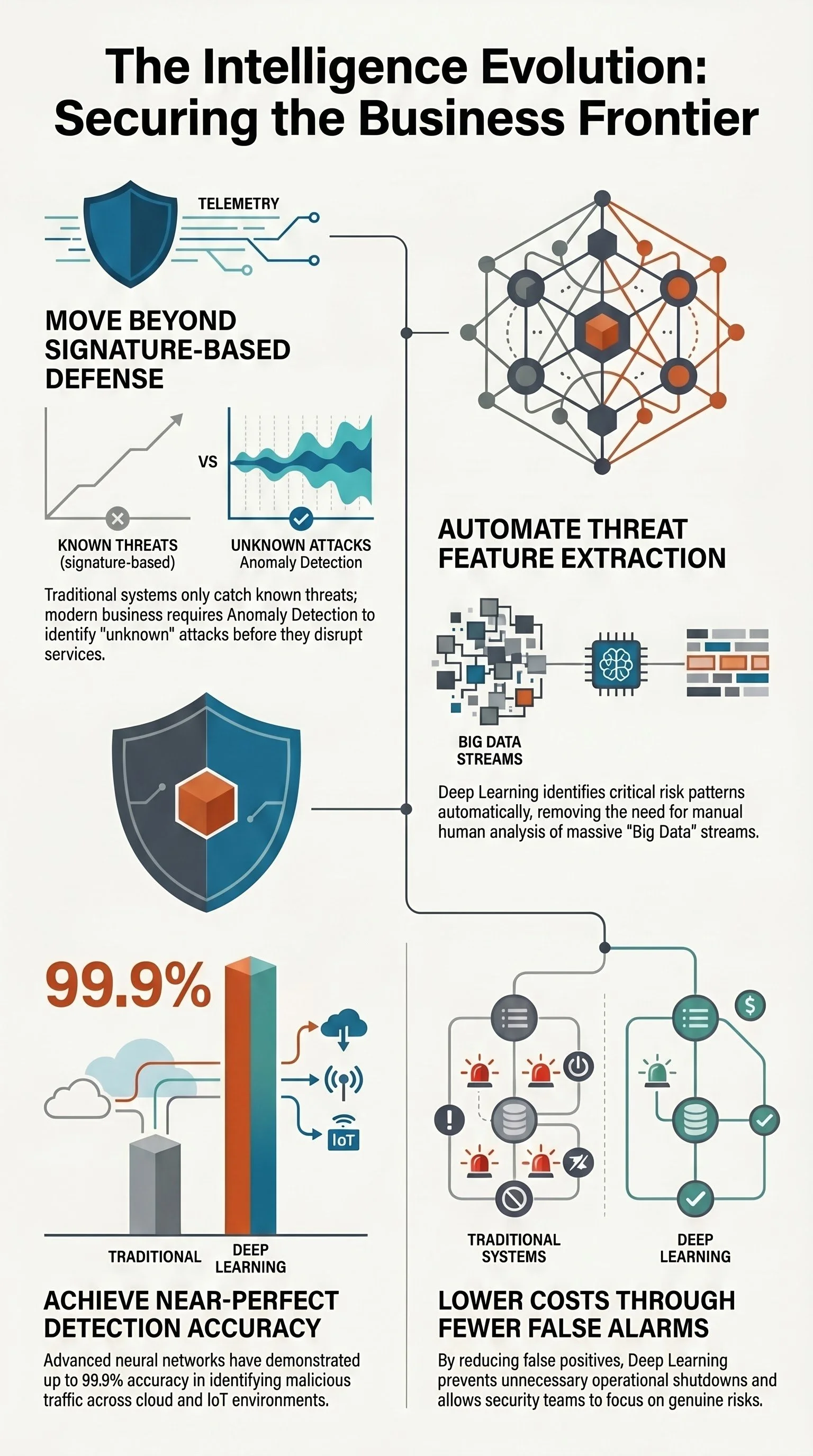
The Evolution of Defense: From Checklists to Intuition
To understand why Deep Learning is a game-changer, it helps to understand the limitations of what came before it.
Traditional rules-based cybersecurity operates like a guard with a static list. If a threat is on the list (a known “signature”), the guard blocks it. But if a malicious actor puts on a disguise or uses a new tactic, they walk right through the front door.
Basic Machine Learning upgraded this guard. Instead of just a list, the ML system is given specific examples by human experts about what “suspicious” looks like. In data science, this human intervention is called a training set with engineered features. The problem? It requires constant human hand-holding. Furthermore, when traditional ML is fed too much data, its performance plateaus.
Deep Learning completely flips this model.
Instead of waiting for a human to tell it what a threat looks like, a Deep Learning system ingests massive amounts of raw, unstructured data and figures it out on its own. It acts less like a guard with a checklist and more like a seasoned detective who can instinctively spot anomalous behavior, even if they have never seen the specific parameters before.
The ROI of Deep Learning in Cybersecurity
For business leaders, investing in Deep Learning-powered Intrusion Detection Systems (IDS) translates directly to operational efficiency and ROI. The research highlights three distinct business advantages.
Scaling with Big Data
While traditional systems choke on the massive data generated by modern enterprise networks, Deep Learning actually thrives on it. The more data you feed a Deep Learning neural network, the smarter and more accurate it becomes. This makes it the only viable solution for vast, complex environments like the Internet of Things (IoT) or massive cloud architectures.
Drastically Reducing False Alarms
Alert fatigue is a massive drain on security operations centers (SOC). Traditional anomaly detection systems are notorious for flagging legitimate business traffic as “attacks”, wasting valuable responder time. Deep Learning models have proven capable of identifying threats with high accuracy while keeping the false positive rate low.
Future-Proofing Against Unknown Threats
Because Deep Learning can learn representations of data at multiple levels of abstraction, it is highly effective at identifying subtle, complex, and entirely new attack patterns that legacy systems miss entirely.
The Hidden Caveats: What the C-Suite Must Know
While Deep Learning offers unparalleled protection, it is not a magic wand. The research points out a few strategic challenges that leadership must account for before overhauling their security stack.
The “Black Box” Problem
Deep Learning is incredibly accurate, but it is notoriously difficult to interpret. Because it doesn't rely on human-made rules, it cannot easily explain why it flagged a certain event as an attack. This lack of transparency can be frustrating for compliance teams who need to document the exact nature of a security event.
Data is the Ultimate Bottleneck
An AI is only as smart as the data it trains on. If an organization relies on outdated datasets that don't include modern attack vectors, the Deep Learning model will fail to protect the network. Maintaining up-to-date, high-quality data is an ongoing operational requirement.
The Infrastructure Tax
Deep Learning requires serious computational power. Unlike older software that could run on standard computer processors (CPUs), Deep Learning requires high-end hardware like Graphics Processing Units (GPUs) to analyze data in near real-time.
Actionable Insights: 3 Steps for Business Leaders
You don’t need to be a data scientist to lead the transition toward AI-driven security. Here are three concrete steps to ensure your organization is prepared for the Deep Learning adoption.
Examine Your Security Data Pipeline
Deep learning algorithms struggle without high-quality, continuous data. Ask your Chief Information Security Officer (CISO): Are we capturing comprehensive, real-time data across our entire network, including cloud and remote endpoints? If your data is siloed, incomplete, or outdated, your future AI deployments may not perform. Make data centralization and modernization your first priority.
Budget for an Infrastructure Upgrade
Do not assume your current security budget accounts for the hardware required for Deep Learning. Work with your IT leadership to assess whether your current infrastructure can support advanced neural networks. You will likely need to shift budget toward high-performance cloud computing or dedicated on-premise GPUs to ensure these systems can process network traffic without slowing down business operations.
Ask for “Hybrid” Solutions from Vendors
When evaluating new cybersecurity vendors, beware of those selling “pure” Deep Learning without addressing the “black box” interpretability and explainability issues. The most effective enterprise solutions right now are hybrid systems. These systems use Deep Learning for its unmatched accuracy and scale, but layer it alongside traditional Machine Learning to provide security teams with human-readable explanations of the threats. Ask vendors specifically how their tools balance high detection rates with explainability.
The Bottom Line
Cybersecurity is no longer just an IT problem, it is a fundamental business risk. The volume and sophistication of modern cyberattacks have outpaced human capacity and legacy software. By embracing Deep Learning, forward-thinking organizations can transition their security posture from a reactive, rule-based bottleneck into a proactive, intelligent engine, protecting their data, preserving their operational efficiency, and securing their competitive edge.