
Zero Trust: The Executive Mandate for Modern Cybersecurity

The End of the “Castle and Moat”
Why Zero Trust is Today’s Most Relevant Security Mandate
Imagine your business as a massive, heavily fortified castle. You’ve spent millions building a thick wall and a deep moat, your firewalls and intrusion detection systems, to keep the bad guys out. But what happens when the enemy is already inside? Or what if your workforce no longer operates inside the castle, but is scattered across the globe, accessing your corporate vault from coffee shops, airports, and home offices?
The traditional “perimeter-based” security model is gone. We live in an era of rapid cloud adoption, the Internet of Things (IoT), and permanent remote work. If your organization still relies on a user’s physical location or network connection to determine whether they should have access to your critical data, your business may be highly vulnerable to a catastrophic breach. The stakes are no longer just digital, as historical cyberattacks on critical infrastructure have proven, network vulnerabilities can now lead to massive physical and operational destruction.
Enter Zero Trust Architecture (ZTA). It is not just the latest IT buzzword, it is a fundamental shift in how businesses protect their bottom line, ensure operational resilience, and maintain a competitive advantage in a dangerous digital landscape.
What is Zero Trust? (And Why the C-Suite Needs to Care)
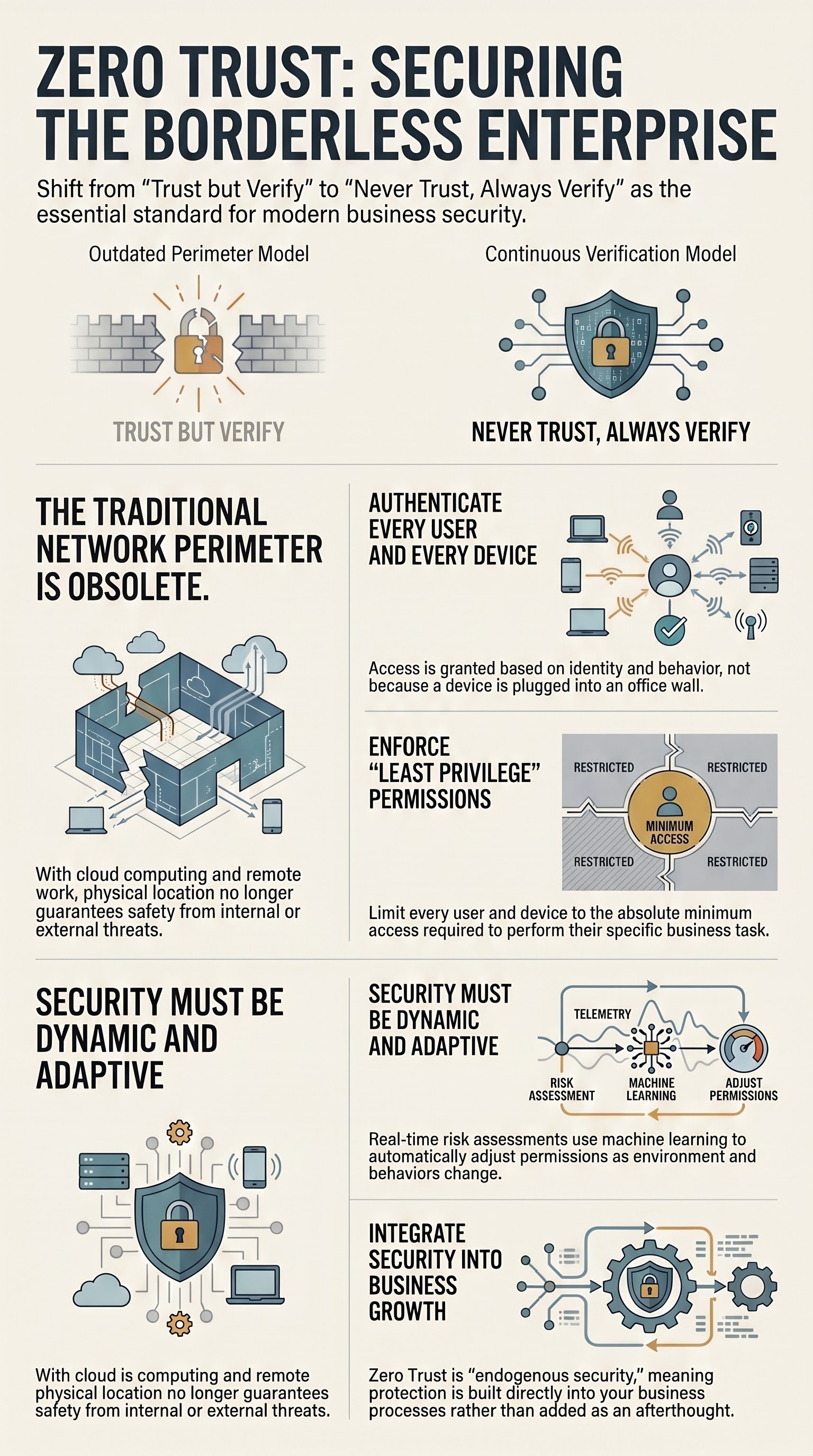
The core philosophy of Zero Trust can be boiled down to a simple mantra: Never trust, always verify.
In the old security model, anyone or anything that made it inside the corporate network was trusted by default. Once a bad actor bypassed the front door, they had a free pass to roam the digital hallways, escalate their privileges, and access whatever they wanted.
Zero Trust flips this paradigm entirely. It assumes that the network is inherently hostile and that external or internal threats are always present inside your walls. Think of it like a high-security facility. Getting past the front gate doesn't mean you can walk into any room. Every single door requires a badge swipe, a biometric scan, and a proven, legitimate business reason for you to be there.
For business leaders and VP-level decision-makers, the return on investment (ROI) of adopting a Zero Trust model is highly strategic.
Limit the “Blast Radius”
By strictly controlling access based on specific tasks rather than broad network entry, a single compromised employee password won't bring down your entire organization.
Secure the Modern, Mobile Workforce
Zero Trust allows your team to work securely from anywhere, on any device, including personal devices (BYOD) or public hosts, without relying on clunky VPNs.
Adapt to Real-Time Threats
As cyberattacks grow more sophisticated, Zero Trust provides a continuous, dynamic defense rather than a static, one-time security check at the door.
The Three Pillars of a Zero Trust Strategy
You do not need a deep technical background to understand how Zero Trust works. Under the hood, this architecture relies on three core operational pillars.
Identity First (Who are you?)
Passwords alone are obsolete. A true Zero Trust system requires robust, multi-factor authentication (MFA) that assesses a user’s location, device, and behavior to prove they are who they claim to be. But it goes much further than a one-time login. The future of Zero Trust relies on continuous authentication. This means the system constantly verifies the user and the device throughout their entire working session. If an attacker hijacks a session, or if an employee's device suddenly behaves strangely, access is instantly revoked.
Minimum Privilege Access (What do you actually need?)
Once a user’s identity is securely confirmed, they aren't given the keys to the entire kingdom. They are granted the absolute minimum permissions required to do their specific job at that specific moment. Using role-based and attribute-based access controls, the network ensures that a marketing manager cannot accidentally (or maliciously) access the HR payroll database.
Dynamic Trust Assessment (Are you acting suspicious?)
A Zero Trust system acts as an ever-watchful, intelligent auditor. It continuously evaluates the “trust level” of every user and device by feeding massive amounts of activity data into machine learning algorithms. The system constantly analyzes context: Are they logging in from a new location? Is it 3:00 AM? Are they trying to download thousands of files? Security access policies are then dynamically adjusted in real-time based on these exact risk factors.
Actionable Insights: 3 Steps to Start Your Zero Trust Journey
Transitioning to a Zero Trust architecture doesn’t mean ripping out all of your existing infrastructure overnight, it is a calculated, step-by-step evolution. Here are three concrete actions business leaders can take to initiate this shift.
Step 1: Examine and Map Your Digital Assets
You cannot protect what you cannot see. Start by identifying your most critical data, applications, and assets. Work with your IT leaders to understand exactly who needs access to them and how that data flows across your organization. Zero Trust fundamentally requires that all network traffic is visualized and analyzed.
Step 2: Upgrade to Continuous, Multi-Factor Authentication
If you haven’t already, consider mandating multi-factor authentication across your entire enterprise. Next, ask your security teams about moving beyond single-factor or one-time logins and begin exploring continuous authentication solutions that monitor device health and user behavior throughout their entire workflow.
Step 3: Shift from “Static” to “Dynamic” Permissions
Move away from blanket access models that give users permanent, broad access to your network. Consider implementing dynamic, risk-based access controls that grant permissions based on the context of the request, such as location, time, task, and the current threat environment.
The Bottom Line
Cybersecurity is no longer just an IT problem, it is a boardroom priority. The complexity of corporate networks and the volume of cyber threats will only continue to accelerate in the coming years. Relying on a traditional perimeter defense is a losing battle. By adopting a Zero Trust Architecture, you aren’t just upgrading your software, you are fundamentally transforming your business to be more resilient, agile, and secure in an unpredictable digital world. Trust nobody, verify everything, and protect your bottom line.