
Leveraging Machine Learning for Next-Gen Cyber Defense

Modern Businesses Run in Cyberspace
Its Attack Surface Has Never Been Larger
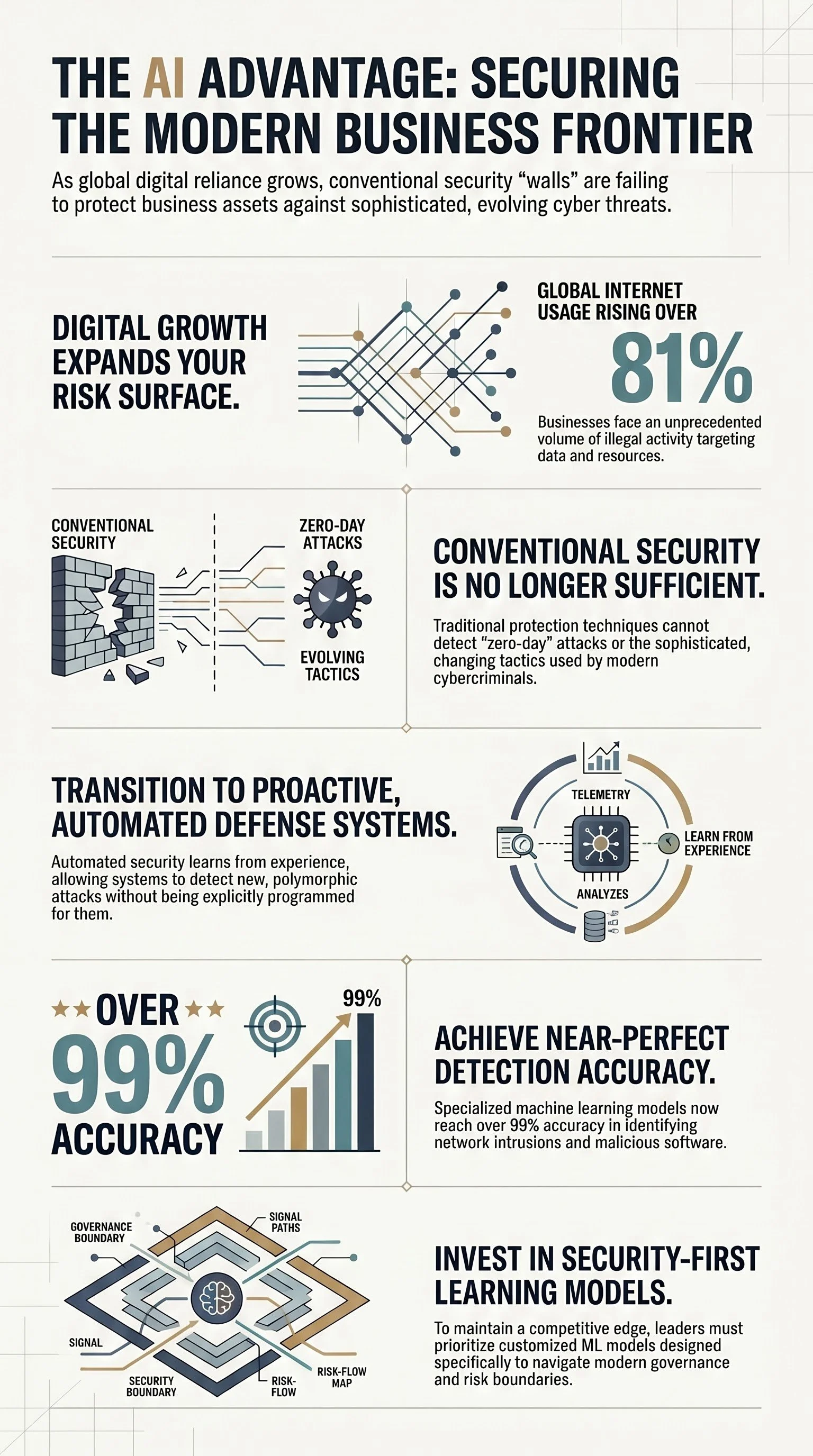
The modern business landscape runs entirely on cyberspace, and with internet usage rising exponentially worldwide, the attack surface for your organization has never been larger. Bad actors are no longer lone hackers in basements, they operate as sophisticated organizations constantly changing their techniques to slip past traditional corporate defenses.
The hard truth for business leaders is this: if your company is still relying on legacy, conventional cybersecurity systems, you are essentially leaving the front door unlocked. Conventional techniques are fundamentally incapable of detecting new, “zero-day” attacks or highly sophisticated intrusions. They rely on unqualified users, weak configurations, and static rules that inadvertently strengthen the hand of bad actors.
The future of enterprise security, and the only viable way to protect your operational efficiency and bottom line, is fully automated cybersecurity. By leveraging machine learning (ML), a subset of artificial intelligence, businesses can deploy systems that automatically learn from experience to detect mutating, polymorphic cyberattacks in near real-time.
However, implementing AI in your security stack is not a one-size-fits-all exercise. Recent performance evaluations of machine learning techniques reveal that maximizing your defensive ROI requires deploying the right algorithms for specific types of threat.
The Problem with “Old School” Security
Think of conventional cybersecurity like a guard checking IDs against a static list. If a bad actor creates a highly convincing fake ID that isn’t on the banned list, they walk right in.
Machine learning changes the paradigm entirely. Instead of needing to be explicitly programmed with a list of known threats, ML acts as an intelligent monitoring network that learns from experience and recognizes malicious behavior. It is the most effective and fundamental strategy to overcome the severe limitations of legacy security systems.
Not All “AI” is Created Equal: Matching the Tech to the Threat
When vendors pitch “AI-driven security” business leaders need to look under the hood. Different cyber threats attack your infrastructure in different ways, and the research shows that specific machine learning models drastically outperform others depending on the job.
Here is how you should think about deploying machine learning across your three biggest threat vectors.
Defeating the Inbox Invaders (Spam & Phishing)
Spam and unsolicited emails are far more than an operational annoyance. They consume massive amounts of network bandwidth, waste valuable employee time, and serve as the primary gateway for fraudulent material and phishing attacks.
The Winning Approach
Deep Belief Networks (DBN). When tested against major benchmark datasets, DBNs consistently outperformed other models, achieving precision rates as high as 98.39% in filtering out malicious emails.
The Business Analogy
Think of a DBN as a deep-cover detective agency. Rather than just looking at the surface-level sender address, it communicates across multiple layers of complex logic to uncover hidden deceptions, stopping phishing attempts before they ever reach your employees’ inboxes.
Stopping the Silent Invaders (Network Intrusions)
Intrusions are reconnaissance missions. Bad actors quietly scan your network and devices to identify vulnerabilities and weaknesses, laying the groundwork for a future breach.
The Winning Approach
Decision Trees (DT). To protect against these silent breaches, an Intrusion Detection System (IDS) powered by Decision Trees is unmatched. In performance evaluations, Decision Trees demonstrated an astounding accuracy rate of 99.96% for spotting unauthorized network access.
The Business Analogy
A Decision Tree operates like a hyper-efficient series of rapid-fire security checkpoints. By following strict “if-then” behavioral rules, it asks a relentless series of instant questions, immediately isolating and flagging anomalous network traffic without slowing down your operations.
Neutralizing the Operations Blockers (Malware & Ransomware)
Malware, including viruses, ransomware, and spyware, is designed to violently disrupt your business operations and compromise the integrity of your corporate data.
The Winning Approach
Support Vector Machines (SVM). Whether analyzing software statically (before it runs) or dynamically (while it runs), SVMs deliver exceptional accuracy, reporting a flawless 100% recall rate in certain threat detection tests.
The Business Analogy
An SVM acts as an uncompromising checkpoint. It excels at mathematically drawing a complex boundary line between safe, legitimate software and operations-blocking malicious code, effectively stopping ransomware before it can execute.
The Caveat: AI Has Vulnerabilities Too
Before you sign off on a massive cybersecurity overhaul, there is a crucial caveat to understand. AI is not invincible. The research clearly indicates that machine learning classifiers are themselves vulnerable to adversarial attacks.
Furthermore, every ML technique struggles to keep pace with continuously upgrading attack vectors. The algorithms are only as smart as the data they learn from, and currently, many systems are trained on datasets that lack diversity or fail to simulate the most sophisticated modern attacks.
Data is the fuel for your security engine, if the fuel is stale, your automated defenses will fail.
Executive Action Plan: 3 Steps to AI-Driven Defense
How do you translate these technical findings into a strategic, competitive advantage? Here are three concrete steps every business leader could take immediately.
Examine Your Security Stack for “Static” Defenses
Perform a review of your current cybersecurity infrastructure. If your organization relies primarily on conventional, signature-based security, like legacy antivirus or static firewalls, you may be vulnerable to modern attacks. Consider a strategic shift toward automated, behavior-based ML solutions.
Ask for “Threat-Specific” AI from Vendors
Do not accept generic claims of “machine learning inside” from your IT partners or software vendors. Ask them which specific algorithmic models they use for different threats. As the research proves, you want examples such as a vendor utilizing Decision Trees for network monitoring, and Support Vector Machines for endpoint malware defense.
Invest in Continuous Data Fuel
The biggest blind spot in AI security is outdated training data. Ensure your security teams and external partners are continuously feeding their ML models with real-time, diverse, and customized datasets. You may consider allocating budget specifically for continuous model training, because your automated defense is only as strong as its most recent intelligence.
The Bottom Line
The digital perimeter as we once knew it is gone. Bad actors are weaponizing sophisticated technology, and the only way to defend the enterprise is to fight fire with automated fire. By deploying the right machine learning models against the right threats, you don't just buy a software license, you build a highly adaptive, autonomous defense system that protects your operational efficiency, your brand reputation, and your bottom line.