
Fortifying the Enterprise Against Generative AI Risks

The Generative AI Gold Rush
Securing Your Enterprise Against the Hidden Risks of Tomorrow’s Tech
Every C-suite executive is currently asking the same question: How can we use Generative AI to outpace the competition?
From streamlining operations to hyper-personalizing marketing and accelerating product development, Generative AI is the most significant technological leap since the cloud. However, in the rush to integrate these powerful tools into daily workflows, many business leaders are inadvertently opening the door to unprecedented corporate liabilities.
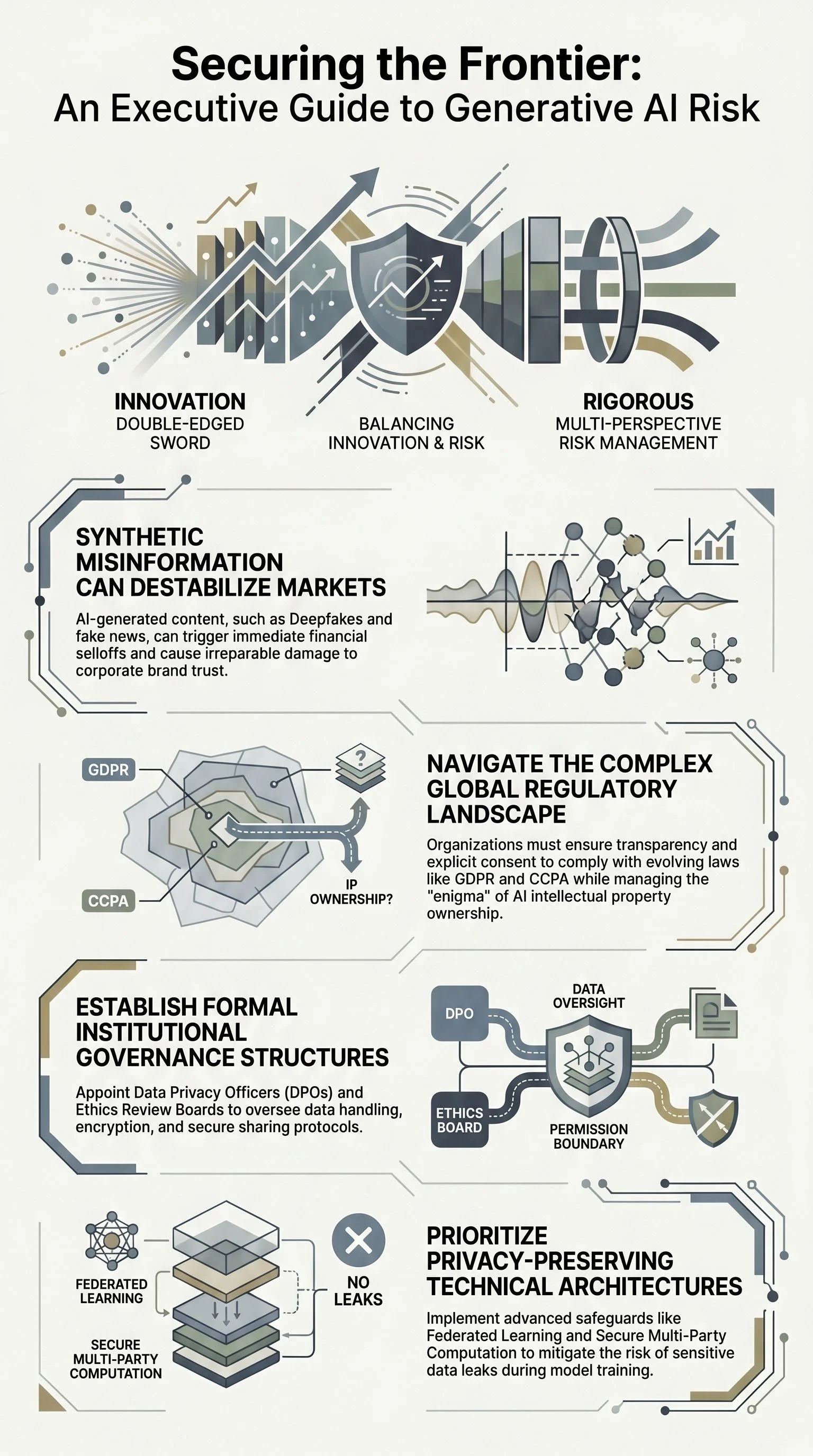
A comprehensive new survey of Generative AI’s privacy and security landscape reveals a critical truth: the very mechanisms that make AI so powerful also make it a massive vulnerability. If left unmanaged, the risks associated with this technology, ranging from deepfake-driven fraud to catastrophic intellectual property leaks, can obliterate consumer trust, invite harsh regulatory fines, and destroy hard, earned market valuation.
Here is what you need to know about the hidden costs of the Generative AI boom, and the strategic steps you must take to protect your enterprise.
The Dark Side of the AI Advantage
For business leaders, understanding the mechanics of how AI algorithms process data is less important than understanding the impact those processes have on the business. Researchers have identified several critical threat vectors that are actively reshaping the corporate risk landscape.
The Weaponization of Identity
We have entered an era where seeing is no longer believing. Deepfake technology, AI designed to manipulate video, audio, and images with terrifying realism, is no longer just a novelty, it is a corporate threat.
For your enterprise, this technology can be used to mimic a CEO's voice to authorize fraudulent wire transfers, or to create a convincing video of an executive making controversial statements that tank your brand’s reputation. Furthermore, these AI models can completely bypass traditional biometric security measures, rendering standard facial or voice recognition protocols vulnerable to attack.
The IP and Copyright Issue
Generative AI models are essentially massive synthesis engines. They ingest colossal amounts of existing data to create “new” content. But what happens when your proprietary code or marketing assets are fed into a public AI tool?
The legal landscape surrounding AI is currently a gray area, presenting a massive intellectual property (IP) puzzle. If an AI generates a new product design or software code based on copyrighted material, determining ownership becomes a legal nightmare. Furthermore, as humans and AI increasingly collaborate to craft content, copyright law struggles to assign “joint authorship” leaving your enterprise’s economic gains from AI-generated assets in a precarious, unprotected state.
The Compliance Question
Global data privacy laws like the GDPR and CCPA were designed to protect classical data, but they struggle to contain the complexities of Generative AI.
Because these AI models require vast datasets to learn, they often inadvertently absorb and memorize personal or sensitive information. If an AI platform accidentally leaks a customer’s personal data in its output, your company could be held liable for massive regulatory violations.
How to Secure Your AI Strategy
The good news is that the technology to secure these models is advancing alongside AI itself. However, legacy cybersecurity protocols are not enough.
To protect your data, think of defense mechanisms in two categories. First, there are methods to keep your proprietary data in-house-such as “Federated Learning” where the AI learns from your data locally on your own devices without ever exporting your raw, sensitive files to an external cloud. Second, there are privacy-preserving techniques, like adding digital “noise” to your data, which allow the AI to extract valuable insights without ever exposing the individual data points beneath.
Your Executive Action Plan
To safely harness the ROI of Generative AI, business leaders must move from reactive cybersecurity to proactive AI governance. Here are three concrete steps you could take today.
Establish an AI Governance Structure
Do not leave AI adoption solely in the hands of implementation teams. Form an internal Ethics Review Board or appoint a Data Privacy Officer specifically focused on AI. This team should establish clear internal policies dictating which AI tools are approved for corporate use, what types of data can be processed through them, and how to maintain unbiased outputs.
Audit and Overhaul Data Handling Procedures
Implement Zero-Trust protocols for how data is collected, stored, and shared with AI models. Ensure that any third-party AI vendors you use have robust encryption, strict access controls, and transparent agreements that prevent your corporate data from being used to train their public models.
Implement AI-Specific Threat Response Plans
Your current cybersecurity incident response plan is likely outdated. Update it to include risk mitigation for AI-specific threats. This includes establishing verification systems to detect synthetic media (deepfakes) targeting your executives, and continuous monitoring to ensure your own AI models aren't being manipulated or reverse-engineered by bad actors.
The Bottom Line
Generative AI is not a passing trend. It is the new operating system for modern business. However, the organizations that will truly dominate the next decade are not just those that adopt AI the fastest but the ones that adopt it the safest. By recognizing the privacy and security blind spots today, you can build the necessary guardrails to turn Generative AI into your ultimate competitive advantage.