
The Enemy Within: Securing the Internal Perimeter

The Invisible Enemy
Why Your Biggest Cyber Threat is Already on Payroll (And How to Stop It)
You've just signed off on a multi-million-dollar cybersecurity budget. You have state-of-the-art firewalls, advanced threat protection, and a team dedicated to keeping hackers and bad actors out of your networks. You’ve built an impenetrable fortress.
But what if the call is coming from inside the house?
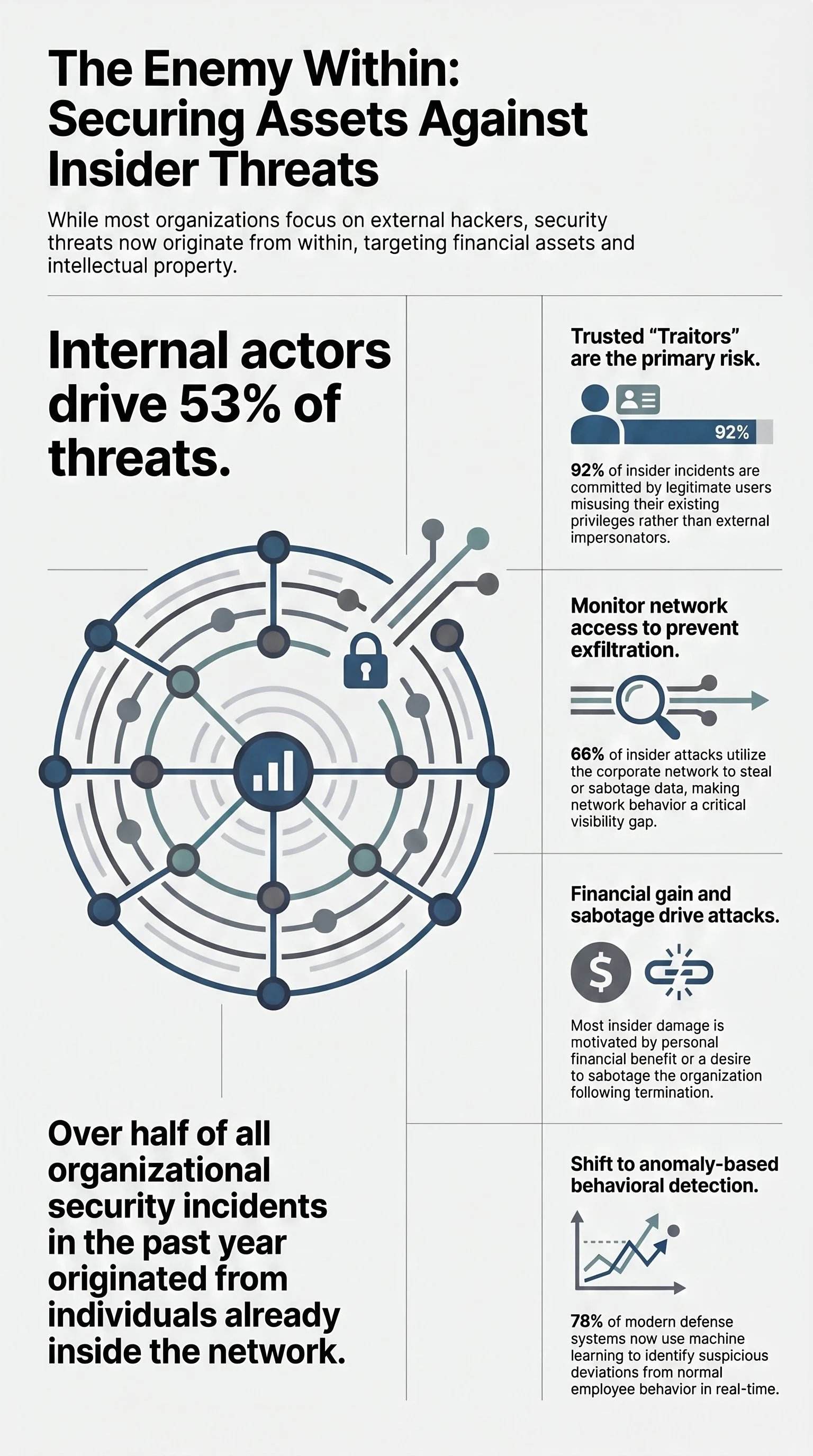
Recent data reveals a staggering reality that many executive teams are fundamentally ignoring: slightly more than half of all cyber threats (53%) originate from inside the organization. We spend endless capital trying to build higher castle walls, completely overlooking the fact that the people who already hold the keys to the kingdom are quietly walking out the backdoor with our most valuable assets.
Insider threats can inflict devastating, often irreversible damage to your company’s financial standing, intellectual property, and market reputation. For business leaders focused on operational efficiency and ROI, protecting the outer perimeter is no longer enough. It’s time to rethink where your true vulnerabilities lie and how to secure your business from the inside out.
The Anatomy of an Insider Threat
When we think of cyberattacks, we often picture a hooded hacker aggressively breaking through digital barriers. In reality, sometimes the most dangerous threat is the trusted employee performing what looks like an everyday task.
Research categorizes these internal actors, and the breakdown should be a wake-up call for any VP or C-suite executive.
The “Traitor” Dominates
A massive 92% of insider threats are categorized as “traitors”, or legitimate, internal users who purposefully misuse their authorized access privileges. They don’t need to hack your systems, they just need to log in.
The Motive is Sabotage and Fraud
These aren’t just accidental data leaks. The vast majority of insider cases are driven by vengeful sabotage (often from disgruntled or terminated employees) and financial fraud.
The Ex-Employee Loophole
Surprisingly, the most common subset of attackers are “outsider affiliates”, specifically, terminated ex-employees. Because they retain intimate knowledge of the organization’s systems and frequently hold deep-seated grudges, they represent a uniquely dangerous risk to your competitive advantage.
Why Your Current Defenses Are Failing
If you ask your IT department how they catch bad actors, they will likely point to antivirus software and intrusion detection systems. But here is the fatal flaw in traditional cybersecurity strategy: external network security tools cannot detect a malicious insider.
An insider already has legitimate access to your network. When a disgruntled engineer downloads a proprietary product blueprint, or a rogue financial officer exports a sensitive client list, the firewall doesn’t sound an alarm because the system sees an authorized user doing their job.
Finding an insider threat is truly like trying to find a needle in a haystack, when the needle looks exactly like a piece of hay. Every day, your employees generate massive volumes of normal activity data (emails, file access, system logins). Malicious actions are drowned out by the sheer volume of this benign daily work. Furthermore, most organizations only use their audit logs for “offline forensics”, meaning they only review the data after a breach has occurred, which is far too late to protect the bottom line.
The Data-Driven Fix: Behavioral Anomaly Detection
To combat insider threats without stifling your team’s operational efficiency, your security infrastructure needs to evolve from perimeter defense to behavioral anomaly detection.
Think of this like your credit card company’s fraud detection system. Your bank knows your normal purchasing habits. If you buy groceries in New York on Tuesday, that’s normal. If your card is suddenly used to buy $5,000 worth of electronics in London on Wednesday, the bank freezes the transaction.
Next-generation insider threat detection works the exact same way. It uses smart analytics to build a baseline profile of what “normal” looks like for your employees. If a mid-level manager typically accesses 10 financial documents a week, but suddenly attempts to download 1,000 sensitive files to an external cloud drive at 2:00 AM, the system flags the anomaly as a potential threat. It bridges the gap between legitimate access and malicious intent.
3 Actionable Steps to Protect Your Bottom Line
Awareness is only the first step. To actively safeguard your intellectual property and maintain your competitive edge, executive leadership must champion the following strategic shifts.
Revamp Offboarding and Implement Dynamic Access Control
Relying on static access policies, where an employee keeps the same system privileges indefinitely, is a massive liability. Access must be continually monitored and dynamically adjusted based on the employee’s current role and behavior. More importantly, because terminated ex-employees represent a massive threat vector, your HR and IT teams must have an airtight, instant offboarding protocol. The second an employee is terminated, all digital and physical access must be revoked simultaneously.
Break Down the Silos Between Cyber and Physical Security
In most companies, physical security (door badges, cameras) and cybersecurity (network logins, file downloads) are managed by entirely different departments. This is a critical blind spot. Roughly 27% of insider threats involve exploiting physical access vulnerabilities. You need a holistic view. If an employee’s badge or keycard is swiped at the front door of your Chicago office, but their credentials are simultaneously being used to log into a server from halfway across the world, your security teams need to know immediately. Combining these data logs provides a much richer, more accurate threat detection system.
Shift Focus to the Human Element
Technology alone cannot solve a human problem. A malicious insider attack is rarely impulsive, it is usually preceded by observable behavioral changes. Fostering a healthy corporate culture and creating safe channels for employee disputes is just as critical to your cybersecurity strategy as any software you can purchase.
The Bottom Line
In the modern digital economy, your data is your competitive advantage. While external threats will always exist, ignoring the enemy within is a strategic failure that business leaders can no longer afford. By shifting your investment toward behavioral detection, integrating your physical and cyber defenses, and treating access as a privilege, you can secure your organization from the inside out, before the damage is done.