
Machine Learning: Predictive Strategies for Financial Fraud Prevention

Stop Losing Revenue
How Machine Learning Transforms Financial Fraud Detection from Reactive to Predictive
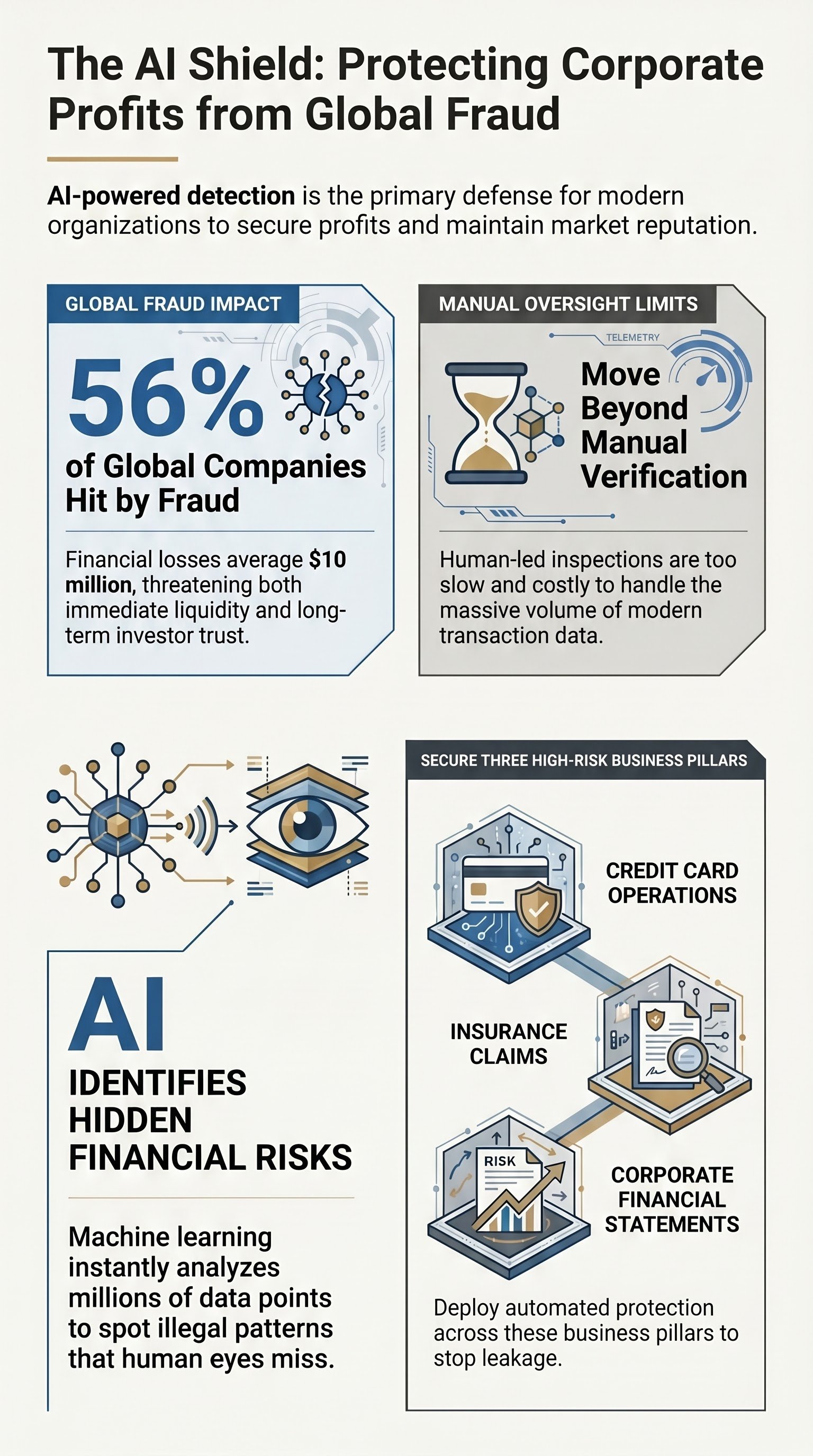
According to recent research, a staggering 56% of companies worldwide have fallen victim to some form of financial fraud. For large enterprises, this isn’t just a compliance headache, it is a direct hit to the bottom line, with average organizational losses potentially reaching millions of dollars.
For decades, businesses have relied on traditional, manual verifications and rigid, rule-based systems to catch bad actors. But in today’s digital economy, these legacy approaches are entirely obsolete. They are too slow, far too costly, and simply cannot process the massive scale and complexity of modern financial transactions.
Enter Machine Learning (ML). Once relegated to the realm of data scientists and academic labs, ML has emerged as a critical strategic lever for C-suite executives. It provides the capability to protect corporate assets, optimize operational efficiency, and outmaneuver increasingly sophisticated bad actors. Here is what recent research reveals about the state of ML in fraud detection, and why it is time to upgrade your company’s defensive playbook.
The Two Fronts of the Fraud War: Inside and Out
When business leaders think of fraud, they often picture an external bad actor stealing credit card numbers. While credit card theft remains the most common form of external fraud, it is only half the battle. Modern businesses are under attack from two distinct fronts, and ML models are uniquely equipped to handle both:
External Threats
This includes credit card fraud, loan application fraud, and insurance fraud (such as staged auto accidents or fake medical billing). ML algorithms excel here by analyzing thousands of variables to detect fraudulent transactions.
Internal Threats
This is the quiet, devastating fraud that happens behind closed doors such as cooked books, manipulated financial statements, tax evasion, and money laundering. ML models can examine vast troves of historical corporate data to detect anomalies.
The Shift from “Diligent Guards” to “Master Detectives”
To understand why ML is so effective, you don’t need a degree in computer science. You just need to understand two basic approaches to how these systems learn:
The “Diligent Guard” (Supervised Learning)
Currently, the vast majority of corporate fraud systems (over 56%) rely on what is called supervised learning. Think of this like a seasoned guard who has been given a “most wanted” list. The system is fed thousands of examples of past fraud and told, “Memorize what this looks like, and alert us if you see it again”. While highly accurate at catching known scams, this approach has a blind spot: it struggles to recognize new, never-before-seen fraud tactics.
The “Master Detective” (Unsupervised Learning)
This is where the true competitive advantage lies. Unsupervised learning doesn't rely on a “most wanted” list. Instead, it analyzes your company’s normal daily operations and learns what “business as usual” looks like. If a transaction or accounting entry suddenly deviates from that baseline-even in a completely novel way, the system flags it. For forward-thinking executives, investing in this methodology is the key to detecting zero-day fraud schemes before they drain your accounts.
The “Needle in the Haystack” Problem
If ML is so powerful, why do some companies still struggle to implement it effectively? The answer lies in the data itself.
In any healthy business, the number of fraudulent transactions is microscopic compared to the millions of legitimate transactions processed daily. In data science, this is known as an imbalanced dataset. Because the system rarely sees a “true” fraud event, it can either become overly sensitive (triggering false positive alerts that frustrate your genuine customers) or too relaxed (letting clever fraudsters slip through).
Overcoming this requires high-quality data. Currently, most models rely purely on structured data, the neat rows and columns of spreadsheets, like transaction amounts, times, and dates. However, researchers note that the next frontier in fraud detection involves tapping into unstructured data. By analyzing the actual text in financial reports, emails, or business documents, modern AI can detect the subtle cues that often precede fraud.
Actionable Insights for the C-Suite
Transitioning your organization from reactive damage control to predictive fraud prevention requires decisive leadership. Here are three concrete steps you should take based on the latest research:
Examine Your Data Ecosystem for “Unstructured” Opportunities
Don’t just rely on numerical transaction data. Ask your Chief Data Officer or IT leadership how the company can begin analyzing unstructured data. Harnessing this untapped goldmine provides your algorithms with the context they need to detect complex fraud.
Request “Proactive” Models from Your Tech Teams
If your current fraud prevention software only relies on supervised learning, you are only fighting yesterday’s wars. Consider challenging your tech leaders to pilot unsupervised learning models (often called “anomaly detection”). This ensures your business is protected against tomorrow’s innovative bad actors rather than just waiting for a known attack to happen.
Pivot Fraud Prevention from a “Cost Center” to a “Revenue Protector”
Think about changing the narrative at the board level. The cost of false positives (declining legitimate customer transactions) and false negatives (letting fraud through) severely damages brand trust and bottom-line revenue. Treat your fraud detection upgrade not as an IT expense, but as a critical operational efficiency project that directly protects ROI.
The Bottom Line
Financial fraud is no longer a simple problem of physical theft, it is a highly organized, technologically savvy enterprise. To compete and protect your market share, your defensive strategies must be equally sophisticated. By embracing the predictive power of machine learning, business leaders can stop merely responding to fraud and start anticipating it, turning security into a silent, unshakeable competitive advantage.