
The Bouncer Strategy: Securing Enterprise RAG Systems

The Generative AI Trust Deficit
Securing Your Enterprise RAG Systems to Protect the Bottom Line
Every business leader today is asking the same question: How do we harness the power of Generative AI without exposing our company to massive risks? We know that out-of-the-box Large Language Models (LLMs) have a costly flaw, when they don't know an answer, they confidently make one up, providing false information instead of admitting a knowledge gap. They also lack inherent access to your proprietary, up-to-date company data.
The business solution to this is a technology called Retrieval-Augmented Generation (RAG). Think of RAG as giving your AI an “open-book test.” Instead of relying purely on generalized past training, a RAG system fetches real-time, highly relevant data from your company's secure internal libraries and feeds it to the AI to generate a precise, accurate answer. This approach is vastly more cost-effective than building a foundational AI model from scratch and leads to more trustworthy customer support automation, personalized recommendations, and advanced enterprise search.
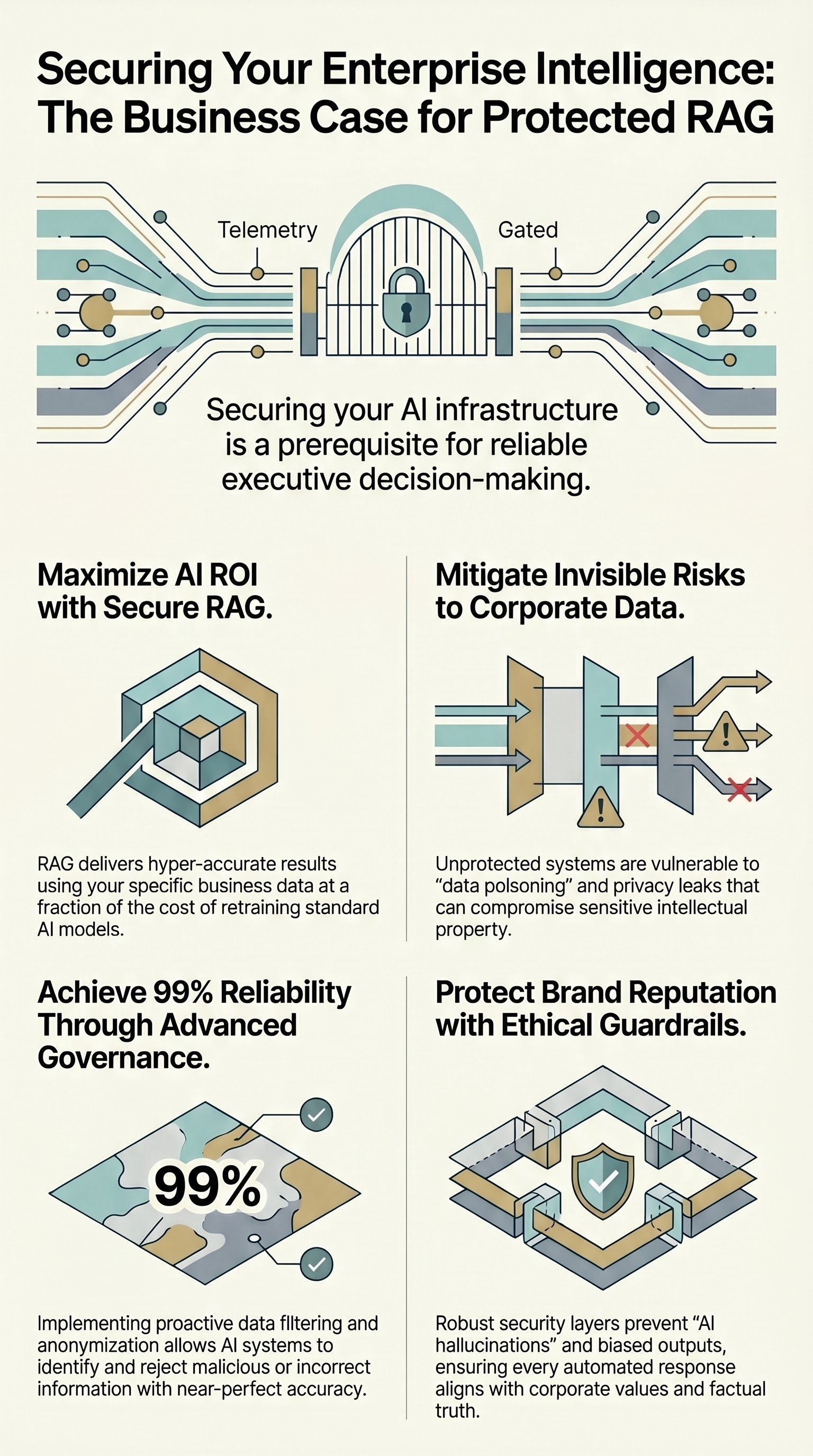
But here is the massive opportunity, and the hidden threat, revealed in recent AI security research: While RAG makes AI smarter, it creates entirely new security blind spots. If you plug your enterprise data directly into an AI without robust, modernized safeguards, you are opening the door to data poisoning, privacy leaks, and compromised decision-making. To protect your brand and ensure actual ROI on your AI investments, you need to understand how to secure these systems before they deploy.
The Hidden Vulnerabilities of Your New AI Pipeline
To understand the threat, you have to look at RAG as a high-speed corporate supply chain. Your AI is the manufacturing plant, and your internal databases are the raw materials. If a bad actor, or even a careless user, introduces contaminated materials into the supply chain, the final product is ruined.
Data Poisoning
Bad actors can intentionally insert malicious data into the external knowledge sources your AI relies on. If your AI retrieves this poisoned data, it will confidently give your customers or employees the wrong information.
Privacy Leakage
Without proper boundaries, an AI might pull sensitive personal data or proprietary trade secrets into a response meant for an unauthorized user.
Model Manipulation and Harmful Outputs
Attackers can craft tricky inputs designed to manipulate the AI into bypassing its safety protocols, leading to biased, harmful, or legally risky outputs.
Historically, businesses have tried to patch these holes using traditional cybersecurity firewalls. However, research shows that traditional methods are simply not efficient enough to handle the complex, conversational nature of Generative AI.
Fighting AI with AI: The "Bouncer" Strategy
So, how do you secure a system that processes complex human language at lightning speed? The answer is to fight AI with AI.
Recent breakthroughs in AI security propose a highly effective model: deploying a specialized, secondary LLM to act as a security filter, a "bouncer", for your primary AI application. Before a user's prompt is processed, or before a piece of data is retrieved from your database, this secondary AI evaluates the query for malicious intent.
It calculates the similarity between the incoming request and known safe data. If a query looks abnormal, manipulative, or toxic, the bouncer instantly rejects it before it ever reaches your core AI system.
The ROI on this approach is staggering. According to recent simulations, this "AI-on-AI" verification model successfully detected and rejected malicious data queries with an accuracy rate of 99.1%. Furthermore, it proved incredibly effective at neutralizing complex cyberattacks, such as Denial of Service (DoS) attacks and sentiment manipulation attempts, identifying them with up to 99% accuracy.
By automating this security layer, businesses drastically minimize manual intervention, speed up data analysis, and dramatically lower the risk of false alarms. You get the speed and innovation of AI, guarded by the tireless vigilance of an automated security expert.
Actionable Insights: 3 Steps to Secure Your Enterprise AI
For C-suite executives and VP-level decision-makers, securing your AI isn't just an IT problem, it's a core business imperative. Based on the latest research, here are three concrete steps you must take to safeguard your RAG-powered applications:
Mandate Rigorous Data “Sanitization” (Audit Your AI's Diet)
Your AI is only as safe as the data it consumes. Before any internal document or database is made available to your RAG system, it must go through rigorous pre-processing. This includes removing irrelevant artifacts and, most importantly, anonymizing the data by stripping out personally identifiable information (PII). This single step builds immense user trust and creates a strong baseline for data protection.
Implement “AI-on-AI” Verification
Do not rely on yesterday's firewalls for tomorrow's technology. Task your engineering teams with implementing secondary LLM evaluation models to act as real-time filters. These verification models should actively monitor both the inputs (what the user asks) and the outputs (what the AI generates) to ensure factual accuracy, moderate language, and detect manipulative attacks before they are executed.
Lock Down Your Data Infrastructure
The foundation of a secure RAG system is robust access control. Ensure your teams are using secure APIs, encrypted data storage, and regulated model access. By tightly controlling exactly who (and what system) has permission to interact with your sensitive knowledge repositories, you protect against unauthorized manipulation.
The Bottom Line
Implementing Generative AI through Retrieval-Augmented Generation is one of the most powerful moves a business can make today to increase operational efficiency and cut computational costs. However, integrating external data into your AI models invites significant security challenges that must be actively managed.
By treating AI security as a proactive strategy, leveraging data sanitization, robust infrastructure, and intelligent AI-based filtering, you ensure your technology remains resilient. The ultimate competitive advantage won't just belong to the companies with the smartest AI, but to the companies whose AI can be completely trusted by their customers, their employees, and their board.
References
Gummadi, V., Udayaraju, P., Sarabu, V. R., Ravulu, C., Seelam, D. R., & Venkataramana, S. (2024). Enhancing communication and data transmission security in RAG using large language models. In Proceedings of the Fourth International Conference on Sustainable Expert Systems (ICSES-2024). IEEE.